Module 4 · Lesson 11 of 18
Cook a simple protein safely
Use a reliable recipe and thermometer guidance rather than color alone; choose an appropriate practice option.
Estimated time; full recipes may take longer.
Why this skill is important
A food thermometer turns a guess into a check. This lesson uses a small boneless chicken breast as one practice route, with a fully vegetarian alternative that reheats safely stored bean-and-rice leftovers. Choose one route. The shared skill is placing the probe correctly, waiting for a stable reading and acting on the result—not judging safety from color, juices or a timer.
Get ready to cook
Gather what you need, check the safety essentials, then follow the method below.
- Read the whole exercise and clear your work area before starting.
- Use the earlier preparation and heat-control lessons as needed.
Gather your tools
- Suitable food thermometer with manufacturer instructions
- Small rimmed oven-safe dish for chicken, or covered saucepan for leftovers
- Tongs or spoon
- Clean serving plate
- Dry oven mitts
Prepare your ingredients
- Chicken route: 1 thawed, boneless skinless chicken breast, about 6–8 oz (170–225 g)
- Chicken route: about 1 teaspoon oil and optional simple seasoning
- Vegetarian route instead: 1–2 portions of bean-and-rice leftovers refrigerated promptly and stored no longer than 3–4 days
- Vegetarian route: a small splash of water
Follow the method
Lesson 11 — Cook a simple protein safely
Read the setup and safety notes first. Follow the actions in order, then use each “Look for” cue to decide what to do next.
1Choose chicken or the vegetarian reheating route
- Choose your route before touching ingredients. For chicken, preheat the oven to 400°F (200°C) and prepare a small rimmed oven-safe dish.
- For the vegetarian route, first verify that the bean-and-rice leftovers were stored safely; discard them if their safe storage is uncertain. Prepare clean serving tools and know that both routes must reach 165°F (74°C).
2Prepare your selected food safely
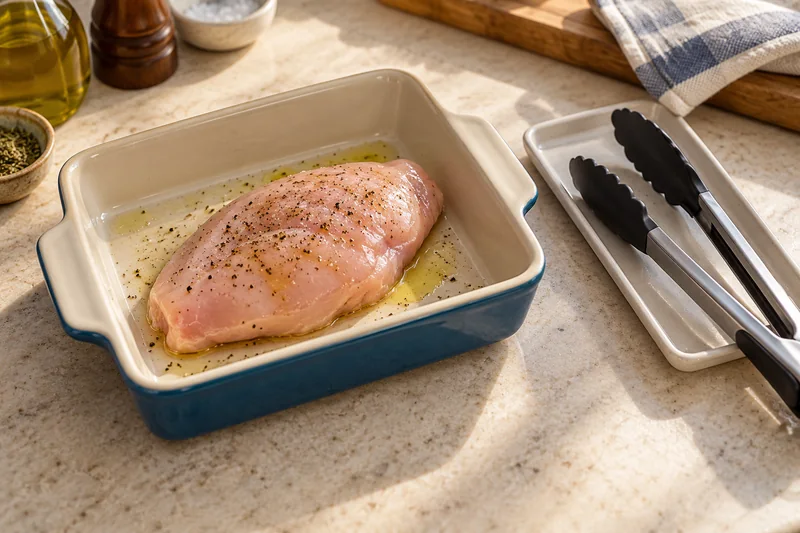
- For chicken, place the thawed breast in the dish, coat lightly with oil and season if desired. Do not wash raw chicken.
- Keep packaging and utensils away from ready-to-eat food; wash hands and contacted surfaces after preparation. For the vegetarian route, put the verified leftovers in a saucepan with a small splash of water.
3Heat, using time only as a reminder
- Bake the chicken in the preheated oven. For this size, start checking around 20 minutes; thickness and ovens vary, so this is not a guarantee.
- For the vegetarian route, cover the saucepan and heat over moderate heat. Stir periodically so the base does not scorch and the middle warms.
4Measure the thickest part and other spots
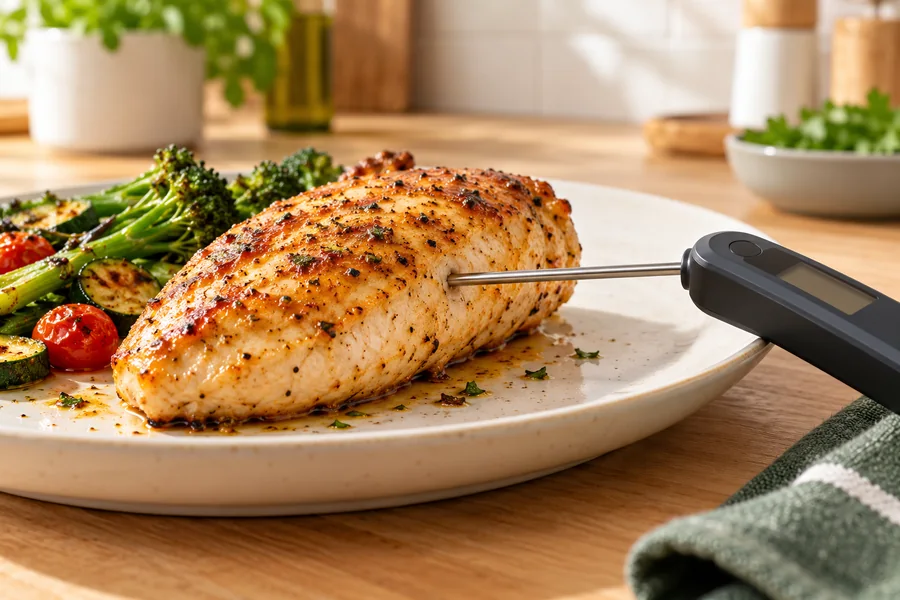
- Using dry mitts, put the chicken dish on a heatproof surface. Insert the probe into the thickest part without touching the dish; wait for a stable reading as directed, then check another thick area.
- For leftovers, stir thoroughly and measure the center and several locations without touching the pan. Clean the probe as directed before and after use, including after checking undercooked food.
5Continue until every checked area reaches 165°F
- If any checked area is below 165°F (74°C), continue cooking or reheating and check again. Never average a low and high reading or assume resting will fix undercooked chicken.
- If chicken browns too quickly, reduce the oven heat and keep checking. Add a little water if the leftovers begin to dry out.
6Serve with clean utensils and record the result
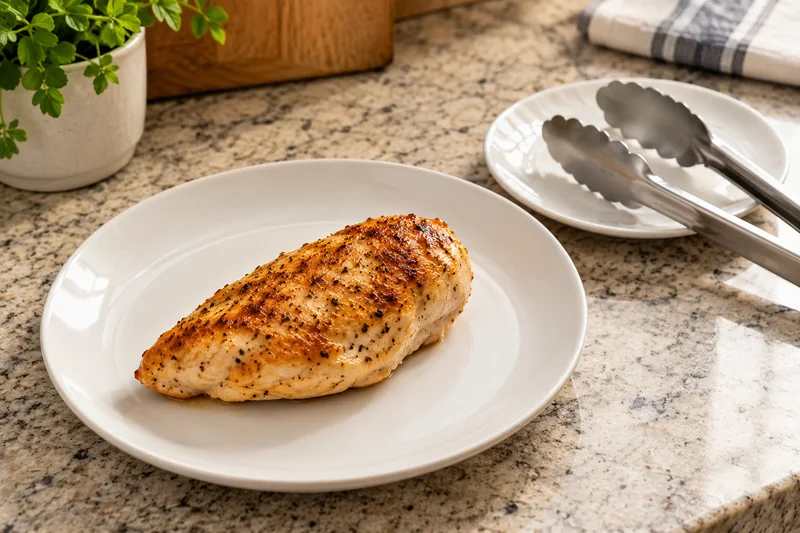
- Turn off the heat. Move chicken to a clean plate with clean utensils; a short rest may make slicing easier, but cannot replace reaching 165°F.
- Serve the reheated beans and rice promptly. Record the thermometer reading and one adjustment.
- Wash equipment and promptly chill any leftovers you plan to keep.
Let’s review what you learned
A temperature-led decision
Choose the ingredient and its correct minimum target
Correct placement → stable reading → check another location
Continue heating and recheck; do not substitute color
Use these checkpoints to guide your own observations and adjustments.
Why the method works
Know the target before heating
For chicken, the minimum internal temperature is 165°F (74°C). Reheated leftovers also need 165°F, but for a different reason: this is a reheating rule, not a universal target for every vegetarian ingredient. Other proteins have different guidance; changing ingredients means checking the relevant target.
Measure the food, not the pan
The probe must reach the food’s center or thickest part without touching the pan or bone. With a thin chicken breast, a suitable thin probe may need to enter from the side. Check your thermometer’s sensing area and response instructions rather than assuming only its very tip measures.
One reading can miss a cool spot
Thicker pieces and dense leftovers can heat unevenly. Check more than one location, and every chicken piece if cooking several. For leftovers, stir before checking so cold areas do not hide beneath a hot surface. A reassuring color is not a substitute for the actual reading.
When something needs adjusting
The thermometer reading changes wildly
Check placement and the required sensing depth. Keep the probe away from the dish and allow the specified response time.
The outside looks done but the center is below target
Continue cooking and check again. Appearance cannot override a low internal reading.
Leftovers scorch before the center heats
Reduce excessive heat, stir more thoroughly and add a small splash of water. Verify several locations after stirring.
Put it into practice
Let the reading decide
Choose chicken or the vegetarian leftover route, not both. Before heating, write down the correct target and where you will place the probe. Take and record the final reading in more than one location. If you cannot access a suitable thermometer, read the lesson and leave the practical exercise unfinished until you can measure properly.
Useful signs of progress
- You selected the correct target for your chosen route.
- You placed the probe away from the cooking vessel and waited for a stable reading.
- You continued heating when needed rather than relying on color.
Check your understanding
Choose an answer for each situation, then read the explanation. You can revise and try again.
Choose your answers, then check your understanding.
Your practice, your pace
After you have read the lesson and tried the practice, use these reflections to record your own progress.
Practice is self-reported, not an assessed qualification.
Sources and lesson notes
Written guidance is informed by these sources. Reading and practice times are estimates; no claim is made that this lesson was practically tested.
- FoodSafety.gov: Safe Minimum Internal Temperatures — Poultry and reheated leftovers 165°F; whole-cut beef/pork/lamb 145°F plus a 3-minute rest; ground beef/pork/lamb 160°F; ground poultry 165°F; fish 145°F; egg dishes 160°F.
- USDA FSIS: How to use a food thermometer? — Place the thermometer in the thickest part, away from bone, fat or gristle.
- USDA FSIS: Should I wash chicken or other poultry before cooking? — Do not wash poultry; splashing spreads contamination and adequate cooking is essential.
- USDA FSIS: How do I handle leftovers safely? — Refrigerate promptly in shallow containers within 2 hours, or 1 hour above 90°F; keep at 40°F or below and use within 3–4 days.