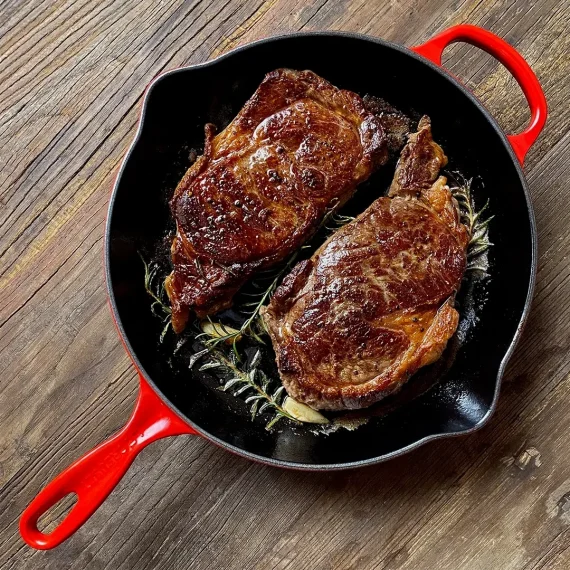
Cast Iron Skillet Steak with Garlic Herb Butter

A steakhouse-quality sear at home — the cast iron skillet technique that gives you a deep mahogany crust and juicy, perfectly cooked steak every time. Ready in under 20 minutes.

10 min Prep Time
12 min Cook Time
22 min Total Time
2 Servings
Medium Difficulty

Ingredients

Servings:
2
Nutrition (per serving)
Calories 620 kcal
Protein 52g
Fat 45g
Saturated Fat 18g
Carbohydrates 1g
Sodium 780mg
Cholesterol 165mg
💾 Storage

Cooked steak is best eaten immediately. Leftovers can be refrigerated for up to 3 days. Slice thin and reheat gently in a skillet over low heat with a splash of beef broth to prevent drying out.

Cast Iron Skillet Steak with Garlic Herb Butter
🍳

Best Made With: Cast Iron Skillet

A 12-inch cast iron skillet is ideal — it holds enough heat to sear two steaks simultaneously without dropping temperature. Lodge's 12-inch is our top pick for this recipe.

See Our Top Cast Iron Skillet Picks →

There is no better way to cook a steak at home than in a cast iron skillet. The pan’s ability to hold and distribute heat evenly creates a crust that rivals any steakhouse — and once you nail this technique, you’ll never go back to the grill for weeknight steaks.

This recipe works for ribeye, New York strip, or sirloin. The key is a very hot, dry pan, a generous amount of salt, and a few minutes of basting with garlic herb butter at the end. We tested this method in both the Lodge 12-inch cast iron skillet and the Le Creuset Signature Skillet — both produced outstanding results, though Lodge’s thicker walls gave a slightly more even sear.

Why Cast Iron Is the Right Tool

Cast iron skillets retain heat far better than stainless steel or nonstick pans. When a cold steak hits a screaming-hot cast iron surface, the pan barely drops in temperature — that’s what creates the deep mahogany crust. Nonstick pans, by contrast, lose heat quickly and steam the meat instead of searing it.

If you’re still deciding between pans, our Best Cast Iron Skillets guide breaks down the top options at every price point. The Lodge 12-inch (under $30) is our top pick for everyday cooking, while the Le Creuset is worth the investment if you want an heirloom piece that lasts a lifetime — see our full Lodge vs Le Creuset comparison for the details.

The Reverse Sear Option

For thicker steaks (1.5 inches or more), consider the reverse sear: start the steak in a 250°F oven until it reaches 10°F below your target temperature, then finish it in a ripping-hot cast iron pan for 60–90 seconds per side. This gives you edge-to-edge doneness with a perfect crust. The cast iron’s heat retention is essential for this final sear to work properly.
Instructions

1

Season generously and let rest at room temperature

Pat steaks completely dry with paper towels — moisture is the enemy of a good crust. Season both sides and the edges liberally with kosher salt and pepper. Let the steaks sit at room temperature for at least 30 minutes (up to 1 hour). This helps the salt penetrate the meat and ensures even cooking.

💡 Pro tip: Dry-brining overnight in the fridge (uncovered on a wire rack) is even better — the salt draws out moisture, then reabsorbs, seasoning the meat deeply and helping form an even better crust.
2

Heat the cast iron skillet until smoking

Place your cast iron skillet over high heat for 3–4 minutes until it begins to smoke lightly. Add the oil and swirl to coat. The pan should be so hot that the oil shimmers immediately. This high heat is what creates the Maillard reaction — the chemical process responsible for that deep, complex crust.

💡 Pro tip: Turn on your range hood or open a window — this process creates smoke. A well-seasoned cast iron handles this heat beautifully; a nonstick pan would be damaged at these temperatures.
3

Sear the first side — do not move the steaks

Carefully lay the steaks in the pan away from you to avoid oil splatter. Press down gently with tongs to ensure full contact with the pan. Cook undisturbed for 3–4 minutes for medium-rare (adjust for thickness). You'll see the bottom edge of the steak turn from red to brown — that's your cue to flip.

💡 Pro tip: Resist the urge to move or press the steaks. Lifting them too early tears the crust before it has formed. If the steak sticks slightly, it's not ready — a properly seared steak releases naturally.
4

Flip and add the butter, garlic, and herbs

Flip the steaks and immediately add the butter, smashed garlic, thyme, and rosemary to the pan. As the butter melts and foams, tilt the pan slightly and use a large spoon to continuously baste the steaks with the aromatic butter. Cook for 2–3 more minutes, basting constantly.

💡 Pro tip: The garlic and herbs infuse the butter with incredible flavor. Keep the basting going — this is what separates a home-cooked steak from a restaurant one.
5

Check doneness and rest the steaks

Use an instant-read thermometer to check internal temperature: 125°F for rare, 130–135°F for medium-rare, 140°F for medium. Remove steaks from the pan and place on a wire rack over a cutting board. Rest for at least 5 minutes — this allows the juices to redistribute throughout the meat.

💡 Pro tip: The steak will continue cooking 5°F after you remove it from the heat (carryover cooking), so pull it 5°F below your target temperature.
6

Slice and finish with flaky salt

Slice the steak against the grain into 1/2-inch strips, or serve whole. Spoon any remaining garlic herb butter from the pan over the top. Finish with a pinch of flaky salt for texture and a final burst of seasoning. Serve immediately.

💡 Pro tip: Slicing against the grain shortens the muscle fibers, making every bite more tender — especially important for less expensive cuts like sirloin.

More to Cook

You Might Also Like

Stay in the loop

Get the Best Kitchen Picks Delivered

New buying guides, honest reviews, and kitchen-tested recipes — straight to your inbox. No spam, ever.