Three straightforward choices for quick checks and oven-roast alarms, with clear guidance on probe placement and heat limits.
Page updated November 2026
All three picks work without an app or account.
More about these picks
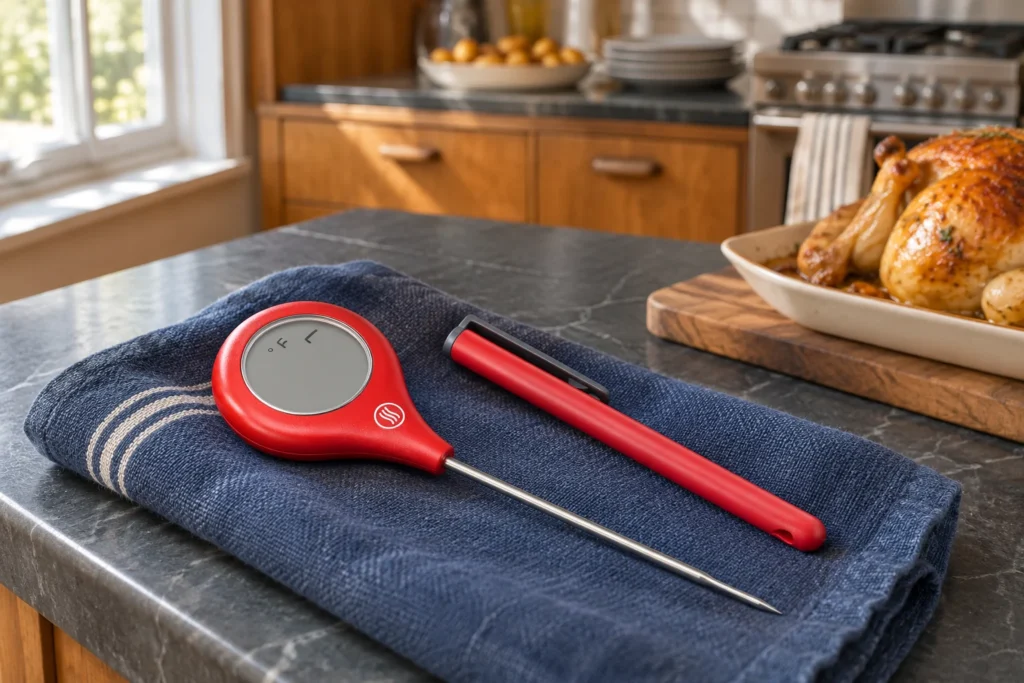
Cover: AI-generated kitchen illustration based on manufacturer model references. Product photos below show the actual equipment.
HomeCookPicks Editorial Team · Specifications checked November 4, 2026.
How we selected: We compared manufacturer specifications, manuals and exact-model listings, and checked government food-safety guidance. We did not test accuracy, response time, water resistance or durability.
As an Amazon Associate, HomeCookPicks earns from qualifying purchases.
A thermometer should answer a specific question. “What is the temperature in the center of this chicken breast?” calls for a spot check. “When does this roast reach my target?” calls for a probe that can stay in place. Trying to make one type do every job is where shopping becomes confusing, and where an otherwise good instrument can be damaged.
Our Picks at a Glance
Accuracy and response figures below are manufacturer specifications, not our measurements. Accuracy applies only within the stated temperature band. A thermometer’s full measuring range is not the temperature its plastic body can withstand.
Rotating backlit display and stabilized hold; typically 2–3 seconds
DOT
One leave-in food probe
±1.8°F from -4–248°F
Wired probe and target alarm; display stays outside the oven
Instant-Read and Leave-In Do Different Jobs
Instant-read: move between foods
Use a handheld probe to check a burger, a second chicken piece or several parts of a casserole. Wait for the reading to settle, remove it and clean it between uses. Neither instant-read pick here should remain inside an oven or grill.
Leave-in: follow one location
A heat-rated wired probe stays in the food while a separate display reports its temperature. An alarm helps you notice a target without opening the oven repeatedly. It still measures only the spot where the sensing tip is placed.
For many kitchens, an instant-read plus a simple leave-in alarm is more useful than an elaborate connected system. The alarm can track the roast while the handheld checks other locations before serving. None of these three requires an app, account or wireless connection.
The Picks in Detail
Straightforward everyday spot checks
ThermoWorks ThermoPop 2
Exact linked model: ThermoPop 2 / AZ-3125-CY, Cayenne Pepper Red. Check the selected seller, included package and return terms.
The main offer did not explicitly state its condition when checked. Confirm the selected condition, seller and return terms before ordering. No stock or price promise.
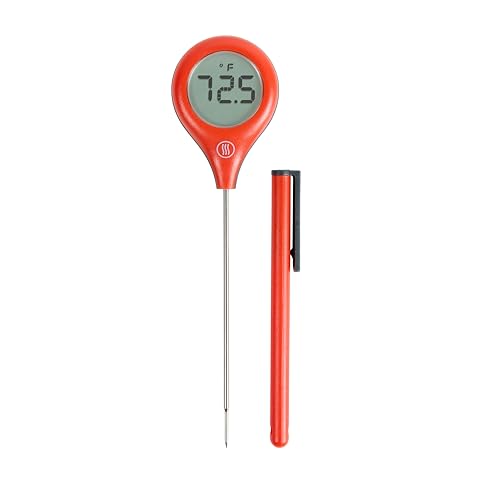
The ThermoPop 2 fits cooks who want a small, uncomplicated tool to keep near the cutting board. Its fixed 4.5-inch probe has a protective sheath, and the backlit display rotates as you turn the instrument. That helps you approach food from either side rather than twisting your wrist to read an upside-down number.
The manufacturer supplies a NIST-traceable calibration certificate and lists IP67 water protection. Those are useful buying details, but they do not eliminate the need to keep it clean, inspect it after damage or use it within the manual’s limits. For cleanup, ThermoWorks recommends a damp, soapy cloth. Don’t submerge the thermometer, put it in the dishwasher or leave it in the oven.
Why choose it
Simple operation, a rotating display and a documented accuracy band that covers ordinary meat-doneness checks.
What to consider
The probe does not fold. Keep track of the sheath, and choose the 4.5-inch version deliberately; the longer 8-inch model has a different response specification.
The main offer did not explicitly state its condition when checked. Confirm the selected condition, seller and return terms before ordering. No stock or price promise.
The Javelin PRO Classic is our alternative for someone who prefers a larger handle with a folding probe. Its two-inch backlit display rotates, and its stabilization feature can hold a settled reading while you press the touch pad. The probe folds into the body for storage, which may suit a crowded utensil drawer better than a fixed stem and separate sheath.
Choose it for that handling style rather than an advertised fraction of a degree. Its stated ±0.9°F accuracy is very close to the ThermoPop 2’s ±1°F in their overlapping cooking range. Correct placement and waiting for a stable reading matter more than treating that tenth of a degree as a meaningful household ranking.
The IP65 rating describes splash resistance. Lavatools’ linked manual says not to immerse the instrument or put it in a dishwasher, and not to leave it in an oven. Its magnetic storage feature is convenient only on a suitable cool surface.
Why choose it
Folding storage, large display, stabilized hold and magnetic attachment.
What to consider
More controls to learn, no continuous oven monitoring, and a water-protection rating that is not permission to soak it.
Source: Javelin PRO Classic specifications and linked manual. The current product is named Classic; some manufacturer support text retains the earlier PRO Duo name.
Simple leave-in alarm for a roast
ThermoWorks DOT
Exact linked model: DOT / AZ-1225-NB, Nautical Blue. Check the selected seller, included package and return terms.
The main offer did not explicitly state its condition when checked. Confirm the selected condition, seller and return terms before ordering. No stock or price promise.
The DOT is the pick for a cook who wants to set one temperature target and hear an alarm. It includes one Pro-Series 4.5-inch straight penetration probe, connected by a 47-inch cable. The display shows the current temperature and the alarm setting, with arrow buttons to adjust the target.
There is no need to pair a phone or manage a network. That simplicity also defines its limits: one channel tracks one location, and this is not a multi-probe remote monitoring system. It complements a handheld thermometer rather than replacing one for checking several pieces of food.
Only the appropriate probe and cable go into the cooking space. Keep the display outside and away from hot appliance surfaces. The probe tip’s upper limit is 572°F; the cable’s higher 700°F rating applies only for short periods and does not make the whole device flame-safe. Keep the cable clear of elements, flames, coals and hot racks, and avoid crushing or sharply kinking it.
Why choose it
A dedicated target alarm with a replaceable probe and clear separation between food and display.
The included 4.5-inch straight probe is model TX-1004X-SP. If the plug is fully seated but the screen still says “NO PROBE,” ThermoWorks recommends trying fresh batteries before replacing the probe.
What to consider
One measurement channel, cable routing to manage, and no permission to use it directly over a searing flame.
Use the manual for probe placement and cable care. Treat the alarm as a reminder to check, not a signal to take the food off the heat. Verify with an instant-read thermometer and keep cooking if any spot you check is below the safe minimum for that food.
Start with the ThermoPop 2. A handheld spot-check tool can move between foods and verify several locations. If you prefer folding storage and a larger handle, choose the Javelin PRO Classic instead; you do not need both.
I roast chicken or larger cuts regularly.
Add the DOT to an instant-read thermometer. Position its probe carefully before cooking, set the alarm, then check other appropriate locations with the handheld before serving.
I cook several burgers or thin cutlets.
Use an instant-read and check each piece. Insert from the side when needed so the sensing tip reaches the center without going through to the hot cooking surface. Do not assume one piece represents every other piece.
I want to monitor a smoker from another room.
These picks prioritize kitchen simplicity. The DOT has no remote receiver, and an alarm is only useful where you can hear it. A separate multi-probe remote system may suit that job better; verify its probe types and actual connection requirements before buying.
Get a Useful Reading, Not Just a Number
Know where the sensor is. Follow the instrument’s insertion-depth guidance. Put the sensing area in the thickest part of the food, away from bone, large fat pockets and the pan. In a thin patty, approach from the side.
Check more than one location. A large roast, poultry joint or casserole can have different temperatures in different places. Reposition a spot-check probe rather than relying on the first convenient measurement.
Wait for stabilization. Manufacturer response times describe specified test conditions. A changing reading may mean the tip is still adjusting or you are moving through different temperatures.
Clean between checks. Follow each manual’s probe-cleaning instructions so raw-food residue is not carried to cooked food. Water resistance is not the same as dishwasher compatibility.
Use current FoodSafety.gov minimum internal temperatures: poultry, leftovers and casseroles reach 165°F; ground beef, pork, lamb and veal reach 160°F; whole beef, pork, lamb and veal steaks, chops and roasts reach 145°F followed by a three-minute rest. Fish reaches 145°F. Do not treat a device’s “rare” preset or a chef-preference chart as a replacement for safety guidance.
For a basic accuracy check, use a properly prepared ice bath, not a glass with a few floating cubes. Pack crushed ice, add enough clean cold water to fill the gaps without floating the ice, allow it to settle and stir. Keep the sensing portion away from the sides and bottom. Compare the settled reading around 32°F with that model’s published tolerance. Follow the manufacturer’s full ice-bath method; do not adjust a nonadjustable instrument or rely on a clearly faulty probe.
Store probes dry and protected. The handheld picks use coin-cell batteries, which must be kept away from children, including spent cells. The DOT uses two AAA batteries. Check battery and probe condition before a large holiday cook rather than discovering a problem after the roast goes in.
Frequently Asked Questions
Can an instant-read thermometer stay in the oven?
Not these models. Their probes can measure hot food, but the instruments are designed for brief handheld checks. For ongoing monitoring, use the DOT’s heat-rated probe while keeping its display outside the oven.
Does the DOT tell me the oven’s air temperature too?
Not simultaneously with food on its single channel. The included penetration probe is intended for food. A compatible air probe is a separate accessory, and measuring both food and air at once requires separate channels or instruments.
Is an infrared thermometer a substitute?
No. An infrared instrument measures a surface, not the internal temperature at the center of a burger or roast. Choose a suitable food probe for those internal checks.
Should I buy the fastest advertised thermometer?
Speed is helpful, especially when checking many pieces, but consider the display, probe geometry, cleaning rules and replacement support too. For these choices, buy the design you will use correctly and consistently.
Exact seller and package details can change; ThermoWorks currently sells selected products on Amazon and advises buying directly from ThermoWorks there. Check the seller rather than assuming an old blanket warning or a similar brand name settles authenticity.