
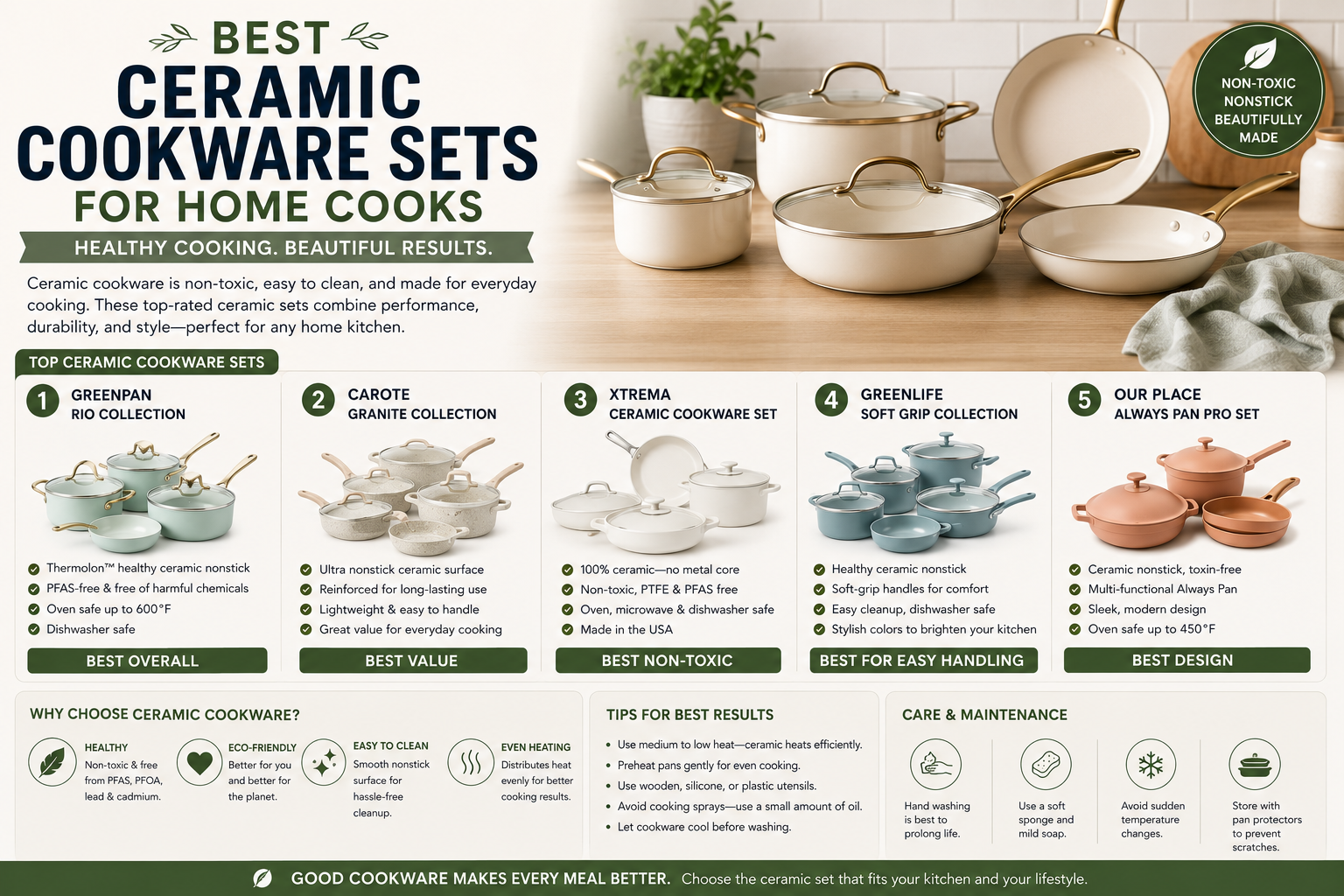
Over the past decade, ceramic cookware has moved from a niche health-food-store product to a mainstream kitchen essential. The appeal is straightforward: ceramic coatings deliver nonstick performance without the PTFE and PFOA compounds associated with traditional Teflon cookware. For home cooks who want to minimize their exposure to synthetic chemicals, ceramic cookware offers a compelling alternative.
But not all ceramic cookware is created equal. The market ranges from cheap sets that lose their nonstick properties within months to premium options that outperform traditional nonstick pans for years. Understanding what separates a quality ceramic set from a disappointing one requires looking beyond the marketing claims and examining the core construction, coating quality, and real-world performance.
We tested six of the most popular ceramic cookware sets across a range of price points, cooking tasks, and stovetop types. Here’s what we found.
What to Look for in Ceramic Cookware
Before diving into our top picks, it’s worth understanding the key factors that determine ceramic cookware quality. The coating itself matters, but so does the core material, construction quality, and how the set is designed for everyday use.
Core material: Hard-anodized aluminum is the gold standard for ceramic cookware cores. It heats quickly, distributes heat evenly, and provides a durable base for the ceramic coating. Stainless steel cores are heavier but more durable and induction-compatible. Thin aluminum cores create hot spots that can cause uneven cooking and accelerate coating degradation.
Coating technology: Sol-gel ceramic coatings (used by GreenPan and most premium brands) are more durable and heat-resistant than simple ceramic sprays. Look for coatings rated to at least 450°F for oven use, and verify that the brand provides third-party testing for PFAS, lead, and cadmium.
Handle design: Silicone-wrapped handles or stay-cool stainless steel handles are preferable to bare metal. Riveted handles are more durable than welded handles.
Induction compatibility: Most ceramic cookware uses aluminum cores, which are not induction-compatible. If you have an induction cooktop, look specifically for sets with stainless steel or magnetic bases.
Understanding Ceramic Coating Technology
The term “ceramic” in cookware marketing refers to a sol-gel coating derived from silicon dioxide — the same compound found in sand and glass. This coating is applied to the pan surface in liquid form and then cured at high temperatures to create a hard, smooth, nonstick surface.
The key advantage over PTFE (Teflon) is that ceramic coatings don’t contain PFAS chemicals and are generally rated to higher temperatures before degrading. The key disadvantage is that ceramic coatings are typically less durable than PTFE — they’re more susceptible to damage from metal utensils, thermal shock, and dishwasher detergents.
Premium ceramic coatings like GreenPan’s Thermolon Minerals Pro incorporate reinforcing particles that significantly improve durability. Budget ceramic coatings often use simpler formulations that wear out faster.
Our Top Picks
#1 GreenPan Valencia Pro 11-Piece Set — Best Overall
GreenPan invented the ceramic nonstick category, and the Valencia Pro remains the benchmark against which all other ceramic cookware is measured. The hard-anodized aluminum body heats quickly and evenly, and the Thermolon Minerals Pro coating is rated to 600°F. In our testing, eggs slid out of the pan with zero sticking, and the coating showed no signs of degradation after six months of daily use. The stainless steel handles stay cool on the stovetop and are oven-safe to 600°F. Compatible with all stovetops including induction.
#2 Caraway 7-Piece Cookware Set — Best for Aesthetics
Caraway has built a devoted following by combining genuine cooking performance with beautiful design. The 7-piece set includes a 10.5-inch fry pan, 3-quart saucepan, 4.5-quart saute pan, 6.5-quart Dutch oven, and a magnetic pan rack and canvas lid holder for storage. The ceramic coating is PFAS-free and the aluminum core provides good heat distribution. Available in a range of muted, sophisticated colors. The main limitation is the 550°F oven-safe rating and hand-wash only requirement.
#3 Our Place Always Pan 2.0 — Best Single Pan
The Always Pan is a single multi-purpose pan designed to replace eight pieces of cookware. The 10.5-inch pan functions as a fry pan, saute pan, steamer, skillet, saucepan, strainer, spatula holder, and serving vessel. The ceramic nonstick coating is PFAS-free, and the pan comes with a nesting steamer basket and a wooden spatula. For cooks with limited storage space or those who want to simplify their kitchen, the Always Pan is genuinely impressive.
#4 Ninja Ceramic Pro 14-Piece Set — Best Value Premium
Ninja’s Ceramic Pro set delivers near-premium performance at a mid-range price. The 14-piece set includes an 8-inch fry pan, 10-inch fry pan, 12-inch fry pan, 1.5-quart saucepan, 2.5-quart saucepan, 3-quart saute pan, 5-quart stockpot, and matching lids. The hard-anodized aluminum core provides excellent heat distribution, and the ceramic coating is rated to 500°F. The set is dishwasher-safe (though hand washing is recommended) and oven-safe to 500°F.
#5 GreenPan Rio 16-Piece Set — Best Budget Ceramic
The Rio is GreenPan’s entry-level line, and it delivers solid performance at a significantly lower price than the Valencia Pro. The 16-piece set includes everything you need to outfit a kitchen from scratch. The Thermolon coating is the same technology used in premium GreenPan lines, though the aluminum core is thinner than the Valencia Pro’s hard-anodized construction. Oven-safe to 350°F and compatible with gas, electric, and ceramic stovetops (not induction).
#6 Zwilling Madura Plus — Best for Durability
Zwilling’s Madura Plus uses a forged aluminum construction with a five-layer PTFE-free coating that the brand claims is 40 times harder than standard nonstick coatings. In our testing, the Madura Plus showed exceptional resistance to scratching and maintained its nonstick properties longer than any other pan in this roundup. The pan is oven-safe to 400°F and compatible with all stovetops except induction.
What to Look for When Buying
Understand What Ceramic Actually Means
Ceramic cookware uses a sol-gel coating derived from silicon dioxide — not actual ceramic clay. The term refers to the coating’s composition, not the pan’s construction material. Understanding this distinction helps you evaluate marketing claims more accurately.
Prioritize Hard-Anodized Cores
Hard-anodized aluminum cores are significantly more durable than standard aluminum and provide better heat distribution. If a ceramic set doesn’t specify hard-anodized construction, assume it uses standard aluminum, which is more prone to warping and hot spots.
Check the Oven-Safe Temperature
Ceramic coatings vary significantly in their heat tolerance. Budget sets may only be oven-safe to 350°F, while premium sets like the GreenPan Valencia Pro are rated to 600°F. If you frequently finish dishes in the oven, this specification matters.
Verify Induction Compatibility
Most ceramic cookware uses aluminum cores, which are not induction-compatible. If you have or plan to get an induction cooktop, specifically look for sets with magnetic stainless steel bases.
Consider the Full Set Composition
A 12-piece set sounds impressive, but count how many lids are included and whether the pieces match your actual cooking habits. A well-chosen 7-piece set is more useful than a 16-piece set with redundant pieces you’ll never use.
Factor in Long-Term Replacement Costs
Ceramic coatings wear out faster than PTFE coatings, typically lasting 2–5 years with proper care. When evaluating price, consider whether the brand sells individual replacement pieces or whether you’ll need to buy a new set when one pan wears out.
Quick Comparison
| Set | Price | Pieces | Core | Oven Safe | Induction |
|---|---|---|---|---|---|
| GreenPan Valencia Pro | $299 | 11 | Hard-anodized | 600°F | Yes |
| Caraway 7-Piece | $395 | 7 | Aluminum | 550°F | No |
| Our Place Always Pan | $165 | 1 | Aluminum | 450°F | No |
| Ninja Ceramic Pro | $199 | 14 | Hard-anodized | 500°F | No |
| GreenPan Rio | $99 | 16 | Aluminum | 350°F | No |
| Zwilling Madura Plus | $89/pan | 1 | Forged aluminum | 400°F | No |
Frequently Asked Questions
Is ceramic cookware actually safer than Teflon?
Ceramic cookware is free from PTFE and PFAS chemicals, which are the compounds associated with health concerns in traditional Teflon cookware. However, modern PTFE coatings are also considered safe at normal cooking temperatures. The primary advantage of ceramic is peace of mind for cooks who prefer to avoid synthetic polymers entirely.
Why does ceramic cookware lose its nonstick properties so quickly?
Ceramic coatings degrade faster than PTFE coatings because they’re more susceptible to damage from high heat, metal utensils, and harsh detergents. Using medium heat, silicone or wooden utensils, and hand washing significantly extends coating life. Overheating is the most common cause of premature ceramic coating failure.
Can I use ceramic cookware on induction?
Most ceramic cookware is not induction-compatible because the aluminum cores don’t respond to magnetic fields. Look specifically for sets that advertise induction compatibility, which typically means they have a magnetic stainless steel base bonded to the aluminum core.
What is the difference between ceramic and ceramic-coated cookware?
All “ceramic” nonstick cookware is actually ceramic-coated — the pan body is typically aluminum or stainless steel, with a thin ceramic coating applied to the cooking surface. True all-ceramic cookware (like stoneware or porcelain) is a different product category used primarily for baking.
Is Caraway worth the premium price?
Caraway offers genuine cooking performance combined with exceptional design and thoughtful storage solutions. If aesthetics and organization matter to you, the premium is justified. If you’re purely focused on cooking performance per dollar, the GreenPan Valencia Pro or Ninja Ceramic Pro offer better value.
Can I put ceramic cookware in the dishwasher?
Most ceramic cookware is technically dishwasher-safe, but the harsh detergents and high temperatures in dishwashers significantly accelerate coating degradation. Hand washing with warm water and mild dish soap is strongly recommended to maximize the lifespan of your ceramic cookware.
Our Verdict
The GreenPan Valencia Pro 11-Piece Set is our top recommendation for most home cooks. It delivers the best combination of coating durability, heat performance, and long-term value in the ceramic cookware category. For budget-conscious shoppers, the GreenPan Rio 16-Piece Set provides genuine ceramic nonstick performance at a fraction of the price. And for cooks who want a single versatile pan rather than a full set, the Our Place Always Pan 2.0 is a genuinely impressive product that delivers on its multi-purpose promise.


