
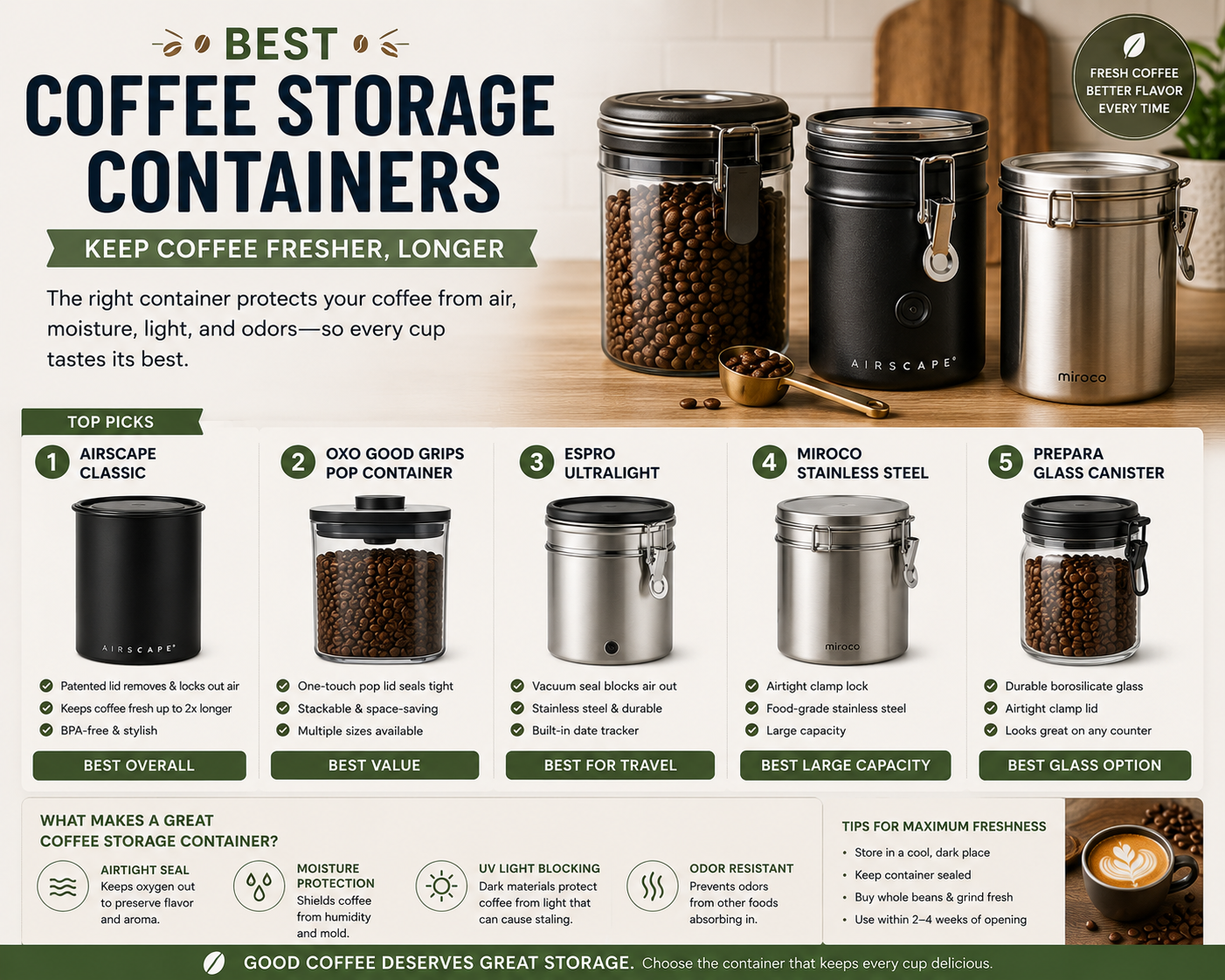
🍳 Best Coffee Storage Containers

✍ Home Cook Picks Editorial Team 🗓 Updated August 11, 2026 🔍 5 products reviewed
ℹ️ Affiliate Disclosure: Home Cook Picks is reader-supported. When you buy through links on our site, we may earn an affiliate commission at no extra cost to you. Learn more →

Storing coffee well is one of the simplest upgrades you can make to improve daily flavor. Freshly roasted beans begin losing aroma and taste the moment they are exposed to oxygen, light, heat and moisture. For home cooks and coffee lovers who grind at home or buy whole-bean coffee in small batches, the right storage container preserves volatile oils and aromatics so your morning cup tastes closer to the roaster’s intent.

This guide walks through the best coffee storage containers for a range of needs: airtight canisters for whole beans, vacuum-sealed vessels for long-term storage, and compact systems for small kitchens. I’ll evaluate materials (stainless steel vs. opaque plastic vs. tin), seal types (silicone gasket, one-way valves, mechanical lids), capacity, and practical features like scoops, stackability and cleaning ease. The goal is to match the container to how much coffee you buy, how quickly you use it, and where you store it.

You’ll find five well-known products from reputable brands, each with pros, cons, and a clear description of what they do best. After the product breakdown I’ll share five practical buying tips to help you choose based on use-case — whether you’re a single-cup brewer who buys weekly or a batch roaster who needs long-term storage. Finally, there’s a short FAQ addressing common concerns like degassing, refrigeration and cleaning. Read on to learn which container will help you keep beans bright, balanced and closer to roast-day flavor.

Choosing the right coffee storage container depends on how quickly you consume coffee and how much counter space you have. For most home brewers who buy one- to two-week supplies, a stainless-steel canister with a strong silicone seal and opaque body — like the Fellow Atmos or Coffee Gator — will protect beans from oxygen and light while being easy to use daily. If you want the maximum shelf life for monthly supply, a vacuum or piston-style system (Tightvac or Airscape) reduces air exposure further and makes long-term storage more practical.

My top practical recommendation for the average home cook is a mid-capacity stainless-steel canister with an airtight gasket and opaque finish: it balances preservation, ease of use and kitchen aesthetics. If you routinely roast at home or buy in bulk, pair that canister with an inexpensive vacuum system or consider a sealed canister with an internal valve to release CO2. Whatever you choose, prioritize an airtight seal, an opaque or stainless body, and a size that fits how many days you use between refills so your coffee stays fresh and flavorful.

What to Look For

Buy the right capacity for your consumption

Match the container size to how quickly you go through coffee. If you use a pound every week, a 1–1.5 pound canister prevents repeated exposure from constant refilling. Buying a massively oversized container and refilling it slowly increases oxygen contact time and accelerates staling. For single-serve households, smaller 8–12 ounce containers reduce waste and keep turnover high, which preserves peak flavor.

Prioritize an airtight seal and opaque material

Oxygen and light are the two biggest enemies of coffee freshness. Look for silicone-gasket lids, one-way degassing valves or plunger/vacuum mechanisms to reduce oxygen exposure. Choose stainless steel or opaque containers rather than clear plastic or glass if the container will sit on a counter. If you must use clear storage, keep the container in a closed cabinet to limit light exposure.

Think about access and workflow

Daily convenience matters: a container that’s difficult to open will be frustrating during morning routines. Wide mouths or removable linings make scooping and cleaning easier, while push-button or flip-top lids speed use. Consider whether you want to keep your canister on the counter for quick access or tucked away in the pantry — the form factor should match your brewing habits.

Use valve-equipped or vacuum systems for fresh-roast degassing

Freshly roasted beans release CO2 for several days — a one-way valve allows that gas to escape without letting oxygen in. If you roast at home or buy very fresh beans and plan to store them for a week or more, choose a canister with degassing capability or a vacuum-style system to avoid built-up pressure and to preserve aromatics. Remember to let very fresh roasts rest a day before sealing if you’re extremely sensitive to flavor shifts.

Keep temperature and humidity stable

Store coffee in a cool, dark, dry place away from heat sources like ovens, dishwashers, or windows. Avoid the fridge and freezer for daily-use beans — repeated temperature shifts and moisture transfer can damage flavor. If you do freeze beans for long-term storage, divide into portion-sized airtight containers and thaw to room temperature before opening to prevent condensation forming on the beans.

Our Top Picks — Reviewed

1
Fellow Atmos Vacuum Canister, 1-Liter
★★★★½ 4.7/5
$79

The Fellow Atmos Vacuum Canister is designed for enthusiasts who want an attractive, functional container that integrates modern features. Its one-way valve allows degassing after roast while preventing oxygen from re-entering, maintaining the balance between venting CO2 and limiting air exposure. The matte stainless-steel body keeps light off the beans and resists fingerprints, so it stays tidy on the countertop.nnInside, the removable liner and wide mouth make scooping and cleaning straightforward. The Atmos works best for storing one to two weeks’ worth of beans; its vacuum-like seal helps maintain aromatics without requiring manual pumps. If you value both aesthetics and practical preservation for daily use, this canister is a strong choice, though its premium price reflects the brand and built-in valve technology rather than bulk-capacity savings.

✅ Pros
  • One-way valve vents CO2 while limiting oxygen exposure
  • Matte stainless body blocks light and looks modern on counters
  • Removable inner liner simplifies cleaning
  • Tight vacuum seal extends freshness for weeks
❌ Cons
  • Higher price than simple canisters
  • Valve needs occasional cleaning to prevent clogging
  • Not ideal for very large bulk storage without multiple units
2
OXO Good Grips POP Container, 1.9-Liter (for Coffee)
★★★★½ 4.5/5
$24

OXO’s Good Grips POP container is a familiar option for home cooks who want an affordable, simple solution for coffee storage. The push-down POP top clicks into place to create an airtight seal, and the compact 1.9-liter size fits roughly a one-pound bag of beans. Its stackable, rectangular design makes it easy to organize cupboards or a pantry shelf without wasting real estate.nnBecause the body is clear plastic, it isn’t ideal for extended light-sensitive storage, so I recommend keeping it inside a cabinet or pantry away from sunlight. For daily use — a week to two weeks of beans — it’s a highly convenient choice: fast access, dishwasher-safe components, and an approachable price point. If you buy in bulk or are extremely sensitive to freshness loss, combining this with shorter turnover or secondary vacuuming might be preferable.

✅ Pros
  • Budget-friendly and widely available
  • Push-button airtight seal is quick to use
  • Clear body lets you see remaining supply
  • Stackable design saves cabinet space
❌ Cons
  • Clear plastic allows some light exposure
  • Gasket can attract oils if not cleaned regularly
  • Not as airtight as vacuum systems over long periods
3
Coffee Gator Stainless Steel Canister with CO2 Release Valve, 1 lb
★★★★½ 4.6/5
$39

Coffee Gator’s stainless-steel canister targets the daily home brewer who wants valve-based degassing without the cost of electric sealing systems. The valve releases trapped CO2 after a fresh roast while preventing outside air from entering, which is especially helpful during the first week after roast. The matte finish helps keep light off the beans and hides fingerprints better than polished steel.nnIncluded accessories like a scoop and bag clip are nice touches for workflow — scoop from the canister, clip the bag, and you’re set. At around one pound capacity this unit is best for single-bag usage, making it an excellent match for people who buy in one-pound increments or who refill weekly. It’s a solid middle-ground choice: better protection than a simple jar but without the complexity or cost of pricier vacuum models.

✅ Pros
  • Built-in CO2 release valve balances degassing and airtightness
  • Durable stainless-steel construction with matte finish
  • Comes with a measuring scoop and bag clip
  • Reasonable price for valve-equipped canister
❌ Cons
  • Valve mechanism adds a small maintenance requirement
  • Smaller 1 lb capacity might require frequent refills
  • Not vacuum-based; long-term storage is limited
4
Airscape Stainless Steel Coffee Canister, 1.5 lb
★★★★☆ 4.4/5
$45

The Airscape canister uses a mechanical internal plunger to expel air and maintain a low-oxygen environment around your beans. Because the plunger sits inside the container, beans stay out of contact with the lid and exterior atmosphere, which reduces oxidation more effectively than many simple lids. The opaque stainless build blocks light and fits a larger volume — suitable for people buying greater than one-pound bags.nnIt’s especially useful for those who want to store roasted beans for multiple weeks or keep one or two bags on hand without sacrificing a lot of flavor. The trade-off is that the plunger-style design takes a bit more effort to open and reseal than a push-button lid, so it’s better for storage and occasional access than constant scooping multiple times daily.

✅ Pros
  • Internal plunger pushes air out for a near-vacuum environment
  • Opaque stainless body blocks light and resists odors
  • Wide mouth makes scooping and cleaning easy
  • Good for medium-term bulk storage
❌ Cons
  • Plunger mechanism can feel stiff until broken in
  • Not ideal for rapid daily access compared with flip-top lids
  • Silicone parts need occasional replacement over many years
5
Tightvac Original Vacuum Sealer (Small, 0.8 lb capacity)
★★★★☆ 4.3/5
$19

The Tightvac Original is a budget-friendly way to reduce oxygen exposure using a simple spring-loaded lid that compresses out air and holds the seal. It’s an efficient option for small batches or for portioning out single-brew servings for travel. The spring mechanism is easy to use and requires no additional accessories, which makes it attractive for those who want a straightforward solution.nnBecause Tightvac relies on mechanical compression rather than an electric vacuum, it offers meaningful improvement over a loose jar but won’t equal professional vacuum-sealed storage for very long-term aging. Still, for weekly turnover and small kitchens where space and price matter, Tightvac provides a practical and portable approach to keeping beans fresher than an open bag.

✅ Pros
  • Affordable vacuum-style storage that removes excess air
  • Durable polypropylene body resists dents and drops
  • Simple one-piece lid lowers to seal without pumps
  • Compact size fits small cabinets or travel
❌ Cons
  • Plastic construction can be light in appearance
  • Not a true vacuum pump — limited long-term air removal
  • Opaque body prevents visual inventory checks

Side-by-Side Comparison

Product Rating Price Best For
Fellow Atmos Vacuum Canister, 1-Liter 4.7/5 $79
OXO Good Grips POP Container, 1.9-Liter (for Coffee) 4.5/5 $24
Coffee Gator Stainless Steel Canister with CO2 Release Valve, 1 lb 4.6/5 $39
Airscape Stainless Steel Coffee Canister, 1.5 lb 4.4/5 $45
Tightvac Original Vacuum Sealer (Small, 0.8 lb capacity) 4.3/5 $19

Frequently Asked Questions

Stay in the loop

Get the Best Kitchen Picks Delivered

New buying guides, honest reviews, and kitchen-tested recipes — straight to your inbox. No spam, ever.