
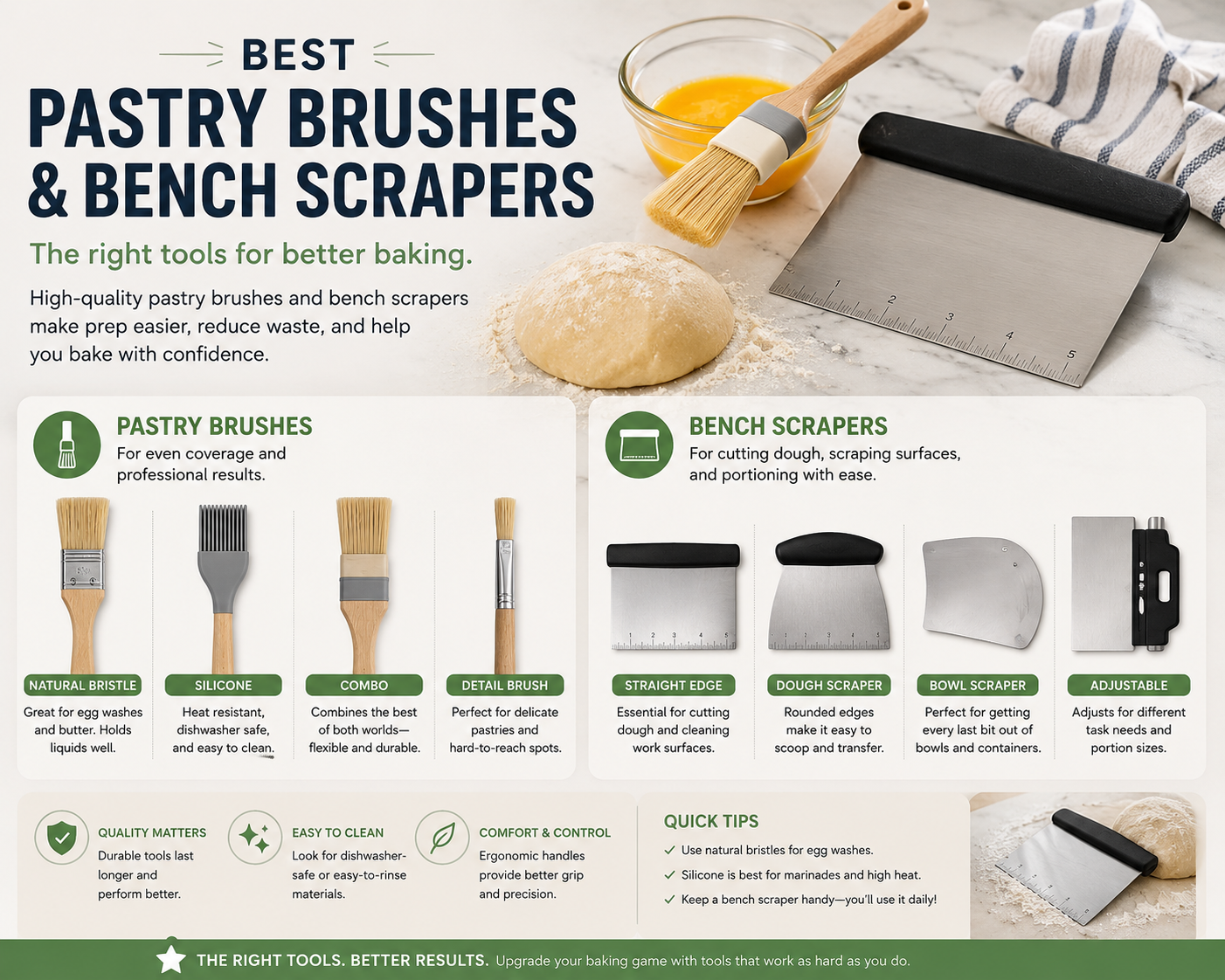
Pastry brushes and bench scrapers are inexpensive tools, but they solve very different problems at the baker’s workbench. A good pastry brush spreads egg wash, butter or glaze in a controlled layer without damaging delicate dough. A good bench scraper divides dough, moves chopped ingredients and clears stuck flour from the counter without forcing you to reach for a knife.
For precise pastry work, our researched top brush is the Ateco 60015 Natural Bristle Pastry Brush. Its 1.5-inch head is wide enough for pie crust and laminated dough but still controlled enough for exposed edges and small pastries. If easy cleanup matters more than maximum finesse, the OXO Good Grips Small Silicone Pastry Brush is the better choice.
Among bench scrapers, the KitchenAid All Purpose Scraper is our best overall pick. Its stainless-steel blade combines a measuring scale with conversion references, a comfortable handle and enough usable width for dividing or transferring dough. The OXO Multi-Purpose Scraper is an excellent alternative for bakers who prioritize grip comfort, while the Dexter-Russell Sani-Safe is built for heavier, professional-style use.
How we selected these tools: This edition is based on current manufacturer specifications, construction, intended use, availability and a review of recent comparative product testing. HomeCookPicks did not perform a new standardized hands-on test for this update, so the article does not claim original measurements or personal testing.
Our top picks at a glance
| Tool | Type | Best for | Dishwasher-safe? | Main limitation |
|---|---|---|---|---|
| Ateco 60015 Natural Bristle Pastry Brush | 1.5-inch boar-bristle brush | Egg wash and delicate pastry | Hand washing recommended | Natural bristles require careful cleaning and may eventually shed |
| OXO Good Grips Small Silicone Pastry Brush | 7.6-inch silicone brush | Easy cleanup and everyday versatility | Yes | Less delicate than fine natural bristles |
| OXO Good Grips Large Silicone Pastry Brush | 10.8-inch silicone brush | Broad surfaces and hot basting | Yes | Oversized for small pastries and detail work |
| KitchenAid All Purpose Scraper | Stainless-steel bench scraper | Best overall dough scraper | Yes | Heavier and more information-dense than simpler scrapers |
| OXO Multi-Purpose Scraper & Chopper | Stainless-steel bench scraper | Comfortable nonslip grip | Yes | Thick handle can take more drawer space |
| Dexter-Russell Sani-Safe Dough Cutter/Scraper | 6 × 3-inch professional scraper | Bread dough and repeated heavy use | Follow manufacturer instructions | More utilitarian; measurement markings are not its main strength |
Best pastry brush overall: Ateco 60015 Natural Bristle Pastry Brush
Best for: Egg wash, melted butter and thin glazes on delicate dough
Brush width: 1.5 inches
Bristles: Natural white boar bristle
Construction: Wood handle with metal ferrule
Care: Hand wash and dry thoroughly
The Ateco 60015 follows the traditional pastry-brush design for a reason. Fine natural bristles pick up a thin liquid and release it gradually, making it easier to paint an even layer of egg wash over pie crust, puff pastry or bread dough. Silicone brushes are more convenient to wash, but their thicker fingers often deposit liquid in heavier streaks. When appearance and control matter, natural bristles remain the better tool.
A 1.5-inch brush is the practical middle size for a home baker. It covers a pie crust faster than a narrow detail brush but does not feel clumsy on croissants, hand pies or the rim of a tart. Ateco also sells nearby widths, but this model is the most versatile place to start if you want only one traditional brush.
The compromise is maintenance. A natural-bristle brush should be cleaned promptly so butter, egg and glaze do not dry near the ferrule. Work warm soapy water through the bristles, rinse thoroughly and let the brush dry with airflow around the head. Do not leave it soaking, which can affect the wood and encourage moisture to remain where the bristles meet the ferrule.
Natural bristles can shed as they age. Inspect the brush before and after every use and remove it from service if the bristles loosen, smell stale or no longer come clean. Reserve a dedicated pastry brush for baking rather than using the same one for raw meat or strongly flavored sauces.
What we like
- Fine bristles spread thin liquids more evenly than most silicone designs
- 1.5-inch width balances coverage and control
- Particularly useful for egg wash on laminated or shaped dough
- Straightforward professional-style construction
- Multiple Ateco brush sizes make it easy to add a wider or narrower version later
What could be better
- Requires more thorough cleaning than silicone
- Wood and a metal ferrule should not be left soaking
- Natural bristles may eventually shed
- Not the best choice for brushing a very hot pan or applying barbecue sauce over direct heat
Who should buy it
Choose the Ateco 60015 if you bake pies, croissants, Danish pastries, brioche or breads where a smooth egg-wash finish matters. It is also useful for brushing excess flour from dough and applying melted butter between pastry layers.
Who should skip it
Skip it if you want a dishwasher-safe tool, regularly brush very hot cookware or prefer not to use animal-derived bristles.
Best easy-clean pastry brush: OXO Good Grips Small Silicone Pastry Brush
Best for: Everyday baking, oiling pans and low-maintenance cleanup
Overall length: 7.6 inches
Bristles: Heat-resistant silicone
Care: Dishwasher-safe
The small OXO silicone brush is a better fit for bakers who value durability and cleanup over the feather-light touch of natural bristles. Silicone does not absorb odors in the same way as a traditional brush, the bristles do not clump after washing and there are no fine hairs to leave behind on a pastry.
OXO’s design adds center bristles with openings intended to hold liquid, addressing a common weakness of basic silicone brushes. It works well for buttering a cake pan, spreading oil, coating sturdier bread dough or applying a glaze. The short overall length also gives the user good control at a countertop.
It is not quite as delicate as the Ateco. Thick silicone fingers can move or mark a fragile dough if the baker presses too hard. Instead of painting repeatedly, load the brush lightly and use gentle overlapping strokes. For an intricate lattice top or small decorative pastry, natural bristles still provide better finesse.
What we like
- Dishwasher-safe and easy to sanitize
- Silicone bristles do not shed like natural hair
- Does not readily retain strong odors
- Compact size provides good control
- Useful for both baking and general cooking
What could be better
- Can leave a streakier finish with thin egg wash
- Silicone fingers are less delicate than fine bristles
- Shorter handle is not ideal for grilling or reaching into a deep hot oven
Who should buy it
Choose the small OXO if you want one easy-care brush for egg wash, melted butter, oil and thicker glazes. It is particularly practical for households that prefer to sanitize kitchen tools in the dishwasher.
Who should skip it
Skip it if your priority is a perfectly thin finish on fragile pastry or you need a long brush for grilling and high-heat basting.
Best large silicone brush: OXO Good Grips Large Silicone Basting and Pastry Brush
Best for: Large loaves, sheet-pan bakes and broader surfaces
Overall length: 10.8 inches
Bristles: Silicone
Care: Dishwasher-safe
The large OXO uses the same general bristle concept as the compact model but provides more reach and coverage. It is the better option for brushing butter over a large sheet of dough, glazing a full loaf, oiling a baking sheet or applying sauce to food near a hot oven or grill.
That size makes it less precise. A nearly 11-inch brush feels excessive when you are trying to coat one hand pie or paint around a narrow decorative edge. Home bakers who mainly make pies and pastries should choose the smaller OXO or the Ateco. Those who frequently move between baking, roasting and grilling will get more use from the larger version.
What we like
- Covers broad surfaces quickly
- Longer handle keeps hands farther from heat
- Dishwasher-safe silicone construction
- No natural bristles to loosen or shed
- Useful beyond pastry work
What could be better
- Too large for detailed pastry finishing
- Holds more drawer space
- Does not match the finesse of a natural-bristle brush with thin washes
Who should buy it
Choose the large OXO if your brush will handle pan oiling, large loaves, sheet-pan recipes, marinades and sauces in addition to pastry.
Who should skip it
Skip it if you want a pastry-only brush for small or intricate work.
Best bench scraper overall: KitchenAid All Purpose Scraper
Best for: Dividing dough, measuring portions and transferring ingredients
Blade: Stainless steel, approximately 6 inches wide
Handle: Textured thermoplastic grip
Markings: Length scale and common measurement equivalents
Care: Dishwasher-safe
The KitchenAid All Purpose Scraper is our best bench scraper for most home bakers because it combines a sturdy blade with genuinely useful reference markings. One side provides a ruler for portioning rolled pastry or checking dough dimensions. The other includes common volume equivalents, which are handy when a recipe or measuring cup uses a different fraction than the one in front of you.
The broad stainless-steel face can lift chopped nuts, chocolate or diced fruit and carry them from a board to a bowl. Its bottom edge divides bread, pizza and pasta dough without exposing a chef’s knife to a flour-covered counter. When the work is done, the same edge clears flour and stuck dough from a smooth work surface.
A bench scraper is not a cleaver. The edge is designed to cut dough and scrape a surface, not chop through bone or hard frozen food. Likewise, aggressive scraping can damage delicate stone, wood finishes or soft countertop materials. Use controlled pressure and follow the counter manufacturer’s care guidance.
What we like
- Strong stainless-steel blade
- Easy-to-read measuring scale
- Common measurement equivalents printed on the tool
- Wide face for lifting and transferring ingredients
- Comfortable grip
- Dishwasher-safe
What could be better
- Heavier than a minimalist scraper
- Markings and handle recesses can collect flour during messy dough work
- Bakers who already use a scale may not need the conversion references
Who should buy it
Choose the KitchenAid if you want one bench scraper for dividing dough, checking dimensions, moving ingredients and cleaning a work surface. It is particularly helpful for rolls, biscuits, pasta and laminated dough that must be divided evenly.
Who should skip it
Skip it if you want the lightest possible scraper or prefer a seamless professional handle with fewer crevices.
Best bench scraper for grip: OXO Multi-Purpose Scraper and Chopper
Best for: Bakers who prioritize hand comfort and a secure nonslip handle
Blade: Stainless steel
Markings: Measurement markings on the blade
Handle: Broad, soft nonslip grip
Care: Dishwasher-safe
OXO’s Multi-Purpose Scraper and Chopper performs the same core jobs as the KitchenAid but emphasizes handle comfort. The rounded Good Grips handle is easy to hold with dry or slightly floury hands, and it spreads pressure across the palm when you push through a firm bread dough.
The stainless-steel blade includes measurement markings for portioning dough and checking pastry dimensions. Its broad face scoops chopped ingredients efficiently and can lift cut cookies or pastry pieces from a board.
The thick handle is both its advantage and its drawback. It is more comfortable during repeated use but takes more drawer space and can feel oversized to someone with very small hands. The edge also should not be treated like a sharpened knife.
What we like
- Soft nonslip handle
- Stainless-steel blade with measurement markings
- Comfortable for repetitive dough dividing
- Broad surface for transferring ingredients
- Dishwasher-safe
What could be better
- Bulky handle occupies more storage space
- Fewer reference details than the KitchenAid
- Not intended for heavy chopping despite the product name
Who should buy it
Choose the OXO if comfort is more important than conversion tables. It is especially suitable for bread bakers who divide many portions in one session.
Who should skip it
Skip it if drawer space is limited or you prefer a straight, narrow professional handle.
Best professional bench scraper: Dexter-Russell Sani-Safe Dough Cutter/Scraper
Best for: Frequent bread baking and professional-style work
Blade size: 6 × 3 inches
Blade: Stainless steel on the verified 19783/S196-PCP model
Handle: Textured polypropylene
Certification: NSF-listed model; verify the exact seller listing before purchase
The Dexter-Russell Sani-Safe is the utilitarian pick for bakers who care more about repeated, controlled use than printed conversions or countertop style. Its 6-by-3-inch format is familiar in commercial kitchens, while the textured polypropylene handle is designed to remain secure during floury or wet work.
This scraper is particularly effective for dividing a large mass of bread dough, lifting sticky portions and clearing a workbench between batches. The broad, uncomplicated blade also makes it easy to sanitize. Because Amazon listings sometimes combine similar Dexter-Russell model numbers and blade descriptions, confirm that the seller’s listing identifies the 19783/S196-PCP stainless-steel model described here.
The Dexter-Russell does not need decorative features to work well, but a home baker may miss the larger ruler and conversion references found on the KitchenAid. Its professional appearance is also more functional than gift-worthy.
What we like
- Professional 6-by-3-inch working size
- Textured Sani-Safe handle
- Rigid blade for dividing substantial dough
- Straightforward construction is easy to clean
- Suited to frequent use
What could be better
- Limited measuring information compared with the KitchenAid
- Similar model numbers can make online listings confusing
- More tool than occasional bakers may need
Who should buy it
Choose the Dexter-Russell if you bake bread often, work with larger batches or want a restaurant-style scraper with a sanitary molded handle.
Who should skip it
Skip it if you want prominent measurement markings, the softest grip or a compact scraper for occasional use.
Do you need both a pastry brush and a bench scraper?
For regular baking, yes. They are complementary rather than interchangeable. The pastry brush applies liquid without tearing or compressing dough. The bench scraper cuts and moves dough without forcing you to drag a knife across the counter.
A pastry brush is most useful for:
- Egg wash on bread, pie and laminated pastry
- Melted butter between dough layers
- Glaze on warm baked goods
- Removing excess flour from a work surface or dough
- Oiling a pan or spreading a thin coating
A bench scraper is most useful for:
- Dividing bread, pizza, pasta and pastry dough
- Portioning rolls or biscuits
- Lifting sticky dough from a counter
- Transferring chopped ingredients
- Cleaning flour and dried dough from a work surface
- Measuring pastry or dough dimensions
Most bakers benefit from one fine natural-bristle brush, one easy-clean silicone brush and one stainless-steel bench scraper. That small group covers delicate work, high-heat or strongly flavored tasks and dough handling without asking one tool to do everything.
How to choose a pastry brush
Natural bristle versus silicone
Natural bristles hold thin liquids and apply them in a smooth layer. They are the better choice for egg wash and delicate pastry, where a heavy or streaky coating can affect appearance. Their disadvantages are slower cleanup, potential shedding and the need for complete drying.
Silicone is easier to wash, resists odor absorption and tolerates higher heat. It is excellent for butter, oil, marinades and thicker sauces. The thicker fingers are less precise, so silicone is not always the best tool for a detailed pastry finish.
Pick the width for the work
A brush between 1 and 1.5 inches is the most versatile for home pastry. Narrower brushes offer better control on small pieces. Wider brushes cover large loaves and pans quickly but can overload an edge with egg wash.
Look at the ferrule and handle
On a traditional brush, the ferrule secures the bristles to the handle. Loose bristles, corrosion or trapped residue are reasons to replace the tool. Wood feels comfortable but should not soak. Molded plastic or silicone handles are easier to sanitize.
How to choose a bench scraper
Blade rigidity
A rigid stainless-steel blade is the most versatile choice for dividing dough and cleaning a flat work surface. Flexible plastic bowl scrapers are useful companions, but they bend too easily for some bench tasks.
A comfortable top edge
The handle should spread pressure across the hand. This matters when dividing cold laminated dough or a large bread batch. A bulky rubberized handle improves comfort, while a narrow molded handle is easier to store and sanitize.
Useful markings
Ruler markings help portion rolls, cut pastry strips and check the thickness or width of dough. Make sure the markings are etched or printed clearly enough to read against stainless steel. Conversion tables are convenient but less important if you already measure ingredients by weight.
Match the edge to the counter
A bench scraper works best on a smooth, durable surface. Use gentle pressure on wood, laminate, soft stone coatings or any counter that scratches easily. A bench scraper is not a substitute for a metal putty knife or cleaning blade.
Cleaning and food-safety tips
Clean a pastry brush immediately after using egg, dairy or raw-meat marinades. For natural bristles, work warm soapy water through the base of the brush, rinse until the water runs clear and dry it with the bristles unobstructed. Replace a brush that retains an odor or sheds.
Silicone brushes and dishwasher-safe scrapers are easier to sanitize, but inspect creases around handles and markings for trapped dough. Dried flour and water become surprisingly adhesive. A short soak after the tool has cooled can loosen residue, but follow the manufacturer’s instructions and never soak a wood-handled brush.
Avoid cross-contamination by keeping a pastry brush separate from a brush used on raw meat. Color coding or storing them in separate drawers can prevent accidental swaps.
Final verdict
The Ateco 60015 Natural Bristle Pastry Brush is the best pastry brush in this guide for careful egg-wash and butter application. Its 1.5-inch head gives home bakers a useful balance of coverage and control. Pair it with the OXO Good Grips Small Silicone Brush when you want easier cleanup, odor resistance or a tool for oil and thicker glazes. Choose the large OXO only if broad coverage and extra reach matter more than detail.
For dough work, the KitchenAid All Purpose Scraper is our best overall bench scraper because its sturdy blade, measuring scale and conversion references make it useful throughout a baking session. The OXO Multi-Purpose Scraper is the comfort pick, while the Dexter-Russell Sani-Safe is built for frequent, professional-style bread work.
None of these tools needs to be expensive or complicated. Buy the brush material that matches the liquid you apply, choose a scraper that feels secure in your hand and clean both tools before dough or egg has time to dry.