
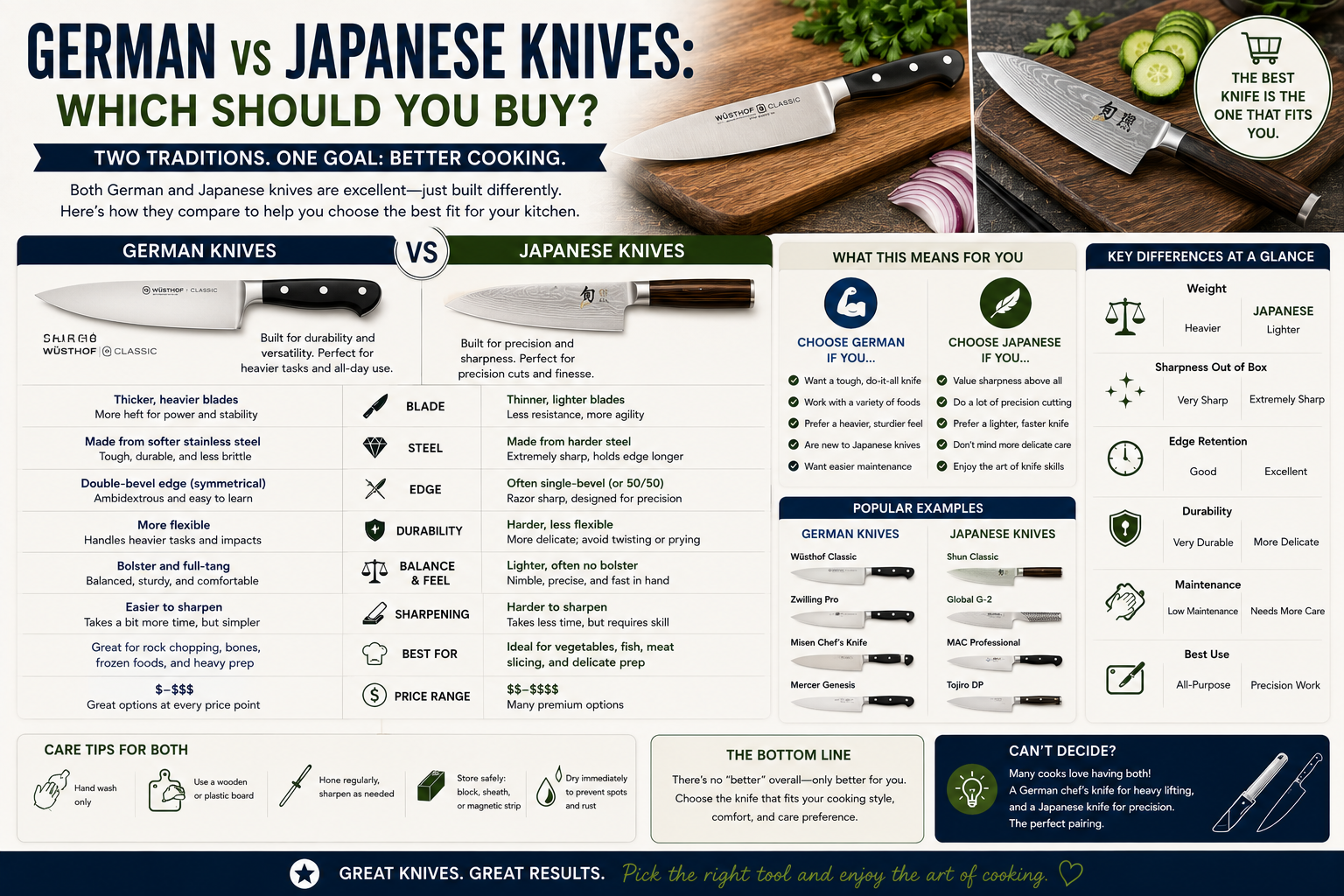
🍳 German vs Japanese Knives: Which Should You Buy?

✍ Home Cook Picks Editorial Team 🗓 Updated August 11, 2026 🔍 5 products reviewed
ℹ️ Affiliate Disclosure: Home Cook Picks is reader-supported. When you buy through links on our site, we may earn an affiliate commission at no extra cost to you. Learn more →

The debate between German and Japanese chef’s knives is one of the most enduring in the culinary world — and for good reason. Both traditions produce exceptional knives, but they reflect fundamentally different philosophies about what a knife should do and how it should feel in the hand.

German knives, exemplified by brands like Wusthof and Henckels, are built for durability and versatility. They use softer steel that is more forgiving of imperfect technique, heavier construction that provides momentum when cutting, and a curved blade profile that suits the rocking motion most Western cooks use. Japanese knives, exemplified by brands like MAC, Shun, and Global, prioritize sharpness above all else. They use harder steel ground to a narrower angle, which creates an edge that is noticeably sharper but also more brittle and demanding of proper technique and maintenance.

This guide explains the key differences between the two traditions and helps you decide which type is right for your cooking style, skill level, and maintenance preferences.

There is no objectively correct answer to the German vs. Japanese question — only the answer that is right for your cooking style. If you are a beginner, cook occasionally, or want a knife you can use and maintain without much thought, start with a German knife. If you cook frequently, enjoy the process of knife maintenance, and want the best possible cutting performance for precision work, a Japanese knife will reward you. Many experienced home cooks eventually own both, using a German knife for heavy-duty tasks and a Japanese knife for precision work — a combination that covers every scenario in the kitchen.

What to Look For

angle
Blade angle is the key technical difference between German and Japanese knives

German knives are typically ground to 15–20 degrees per side (30–40 degrees total). Japanese knives are typically ground to 10–15 degrees per side (20–30 degrees total). The narrower angle of Japanese knives creates a sharper edge but requires harder steel to maintain it — which is why Japanese knives use harder steel that is more prone to chipping.

hardness
Steel hardness (HRC) determines edge retention and brittleness

German knives typically use steel at 56–58 HRC (Rockwell Hardness Scale). Japanese knives typically use steel at 60–65 HRC. Harder steel holds an edge longer but is more brittle. Softer steel is more forgiving and easier to sharpen at home but requires more frequent maintenance.

sharpening
German and Japanese knives require different sharpening tools

German knives can be maintained with a honing steel and sharpened on a whetstone or pull-through sharpener. Japanese knives should be sharpened exclusively on a whetstone — pull-through sharpeners remove too much metal and can damage the thinner blade. If you are not comfortable with a whetstone, a German knife is more practical.

tasks
Match the knife to your most common cutting tasks

If you frequently break down whole chickens, butternut squash, or other hard foods, a German knife's durability is an advantage. If your prep work is primarily vegetables, fish, and precision slicing, a Japanese knife's sharpness will make the work noticeably easier and more enjoyable.

hybrid
Many experienced cooks own both a German and a Japanese knife

The most practical approach for serious home cooks is to own one German knife (for heavy-duty tasks and everyday use) and one Japanese knife (for precision work and delicate ingredients). The Victorinox Fibrox Pro and the MAC Professional together cost about $195 and cover every cutting scenario.

Our Top Picks — Reviewed

Wusthof Classic 8-Inch Chef's Knife (German)
1
Wusthof Classic 8-Inch Chef's Knife (German)
★★★★½ 4.8/5
$175

The Wusthof Classic represents everything that makes German knives exceptional: robust construction, a comfortable weight that provides momentum when cutting, and steel that is forgiving enough to be sharpened at home on a honing steel. The blade is ground to a 14-degree angle per side (28 degrees total), which is wider than most Japanese knives but creates an edge that is more durable and resistant to chipping. This is the knife for cooks who want a reliable, versatile tool that handles everything from delicate herbs to dense root vegetables without complaint.

✅ Pros
  • The definitive German chef's knife — robust, balanced, and durable
  • Softer steel (58 HRC) is more forgiving and easier to sharpen at home
  • Full-tang construction and lifetime warranty
  • Handles heavy-duty tasks like breaking down squash or butterflying chicken
  • Curved blade is ideal for the rocking cutting motion
❌ Cons
  • Heavier than Japanese knives — may fatigue some cooks
  • Thicker blade means slightly more resistance when slicing
  • Requires more frequent honing than Japanese knives
MAC Professional Series 8.5-Inch Chef's Knife (Japanese)
2
MAC Professional Series 8.5-Inch Chef's Knife (Japanese)
★★★★½ 4.7/5
$145

The MAC Professional is the knife that most clearly illustrates the Japanese approach to blade design: thinner, harder, and sharper than German equivalents. The blade is ground to a 15-degree angle per side (30 degrees total in some configurations, but the MAC is notably thin), and the harder steel (around 61 HRC on the Rockwell scale) allows it to hold that edge longer between sharpenings. The trade-off is brittleness — the harder the steel, the more prone it is to chipping if used on hard foods or bones. For precision vegetable prep and protein slicing, the MAC is in a class of its own.

✅ Pros
  • Thinner, harder blade (61 HRC) takes and holds a sharper edge than German knives
  • Lighter weight reduces hand fatigue during extended prep
  • Dimples reduce food sticking for cleaner, faster slicing
  • Exceptional out-of-the-box sharpness
  • Preferred by many professional chefs for precision work
❌ Cons
  • Harder steel is more brittle — more prone to chipping if used on hard foods
  • Requires a whetstone to sharpen properly — a honing steel is less effective
  • Not ideal for heavy-duty tasks like breaking down bones
Victorinox Fibrox Pro 8-Inch Chef's Knife (German-style)
3
Victorinox Fibrox Pro 8-Inch Chef's Knife (German-style)
★★★★½ 4.7/5
$49

The Victorinox Fibrox Pro occupies an interesting position in the German vs. Japanese debate: it uses German-style steel and blade geometry but is stamped rather than forged, making it lighter and less expensive than traditional German knives. For home cooks who want the accessibility of a German-style knife without the weight or cost of a forged option, it is the ideal choice. America's Test Kitchen has rated it their top pick for years, and its performance-to-price ratio is unmatched.

✅ Pros
  • Best value in the German-style category
  • Stamped blade is lighter than forged German knives
  • Non-slip Fibrox handle is comfortable and secure
  • Consistently top-rated by America's Test Kitchen
  • Dishwasher safe
❌ Cons
  • Stamped construction is less durable than forged knives
  • Does not hold an edge as long as forged German or Japanese knives
  • Plastic handle lacks the premium feel of wood or resin
Wusthof Classic 5-Piece Knife Set (German)
4
Wusthof Classic 5-Piece Knife Set (German)
★★★★½ 4.8/5
$399

For cooks who have decided that German knives are the right choice for their cooking style, the Wusthof Classic 5-Piece set is the most logical investment. The consistency of quality across all five knives — same steel, same construction, same balance — is something that a mixed collection cannot replicate. Every knife in this set will perform at the same level and respond to maintenance in the same way, which simplifies the process of keeping your knives sharp and well-maintained.

✅ Pros
  • Complete German knife collection in one purchase
  • Consistent quality and balance across all five knives
  • Lifetime warranty
  • Covers every cutting task in a home kitchen
  • The benchmark for German knife sets
❌ Cons
  • Significant investment
  • Does not include a storage block
  • Heavier than comparable Japanese sets
Victorinox Fibrox Pro 2-Piece Set (German-style, best value)
5
Victorinox Fibrox Pro 2-Piece Set (German-style, best value)
★★★★½ 4.6/5
$79

For cooks who are exploring the German vs. Japanese question and want to start with German-style knives without a large investment, the Victorinox 2-piece set is the most practical starting point. It provides two of the most essential knife sizes at a price that makes it easy to experiment before committing to a premium German or Japanese collection.

✅ Pros
  • Best value entry point for a two-knife German-style collection
  • Both knives share the same reliable Fibrox handle and high-carbon steel
  • Covers the two most-used knife sizes (8-inch and 6-inch)
  • Dishwasher safe
  • Ideal for cooks who want to try German-style before committing to a premium set
❌ Cons
  • Stamped construction is less durable than forged
  • Does not include a honing steel
  • Plastic handles

Side-by-Side Comparison

Product Rating Price Best For
Wusthof Classic 8-Inch Chef's Knife (German) 4.8/5 $175
MAC Professional Series 8.5-Inch Chef's Knife (Japanese) 4.7/5 $145
Victorinox Fibrox Pro 8-Inch Chef's Knife (German-style) 4.7/5 $49
Wusthof Classic 5-Piece Knife Set (German) 4.8/5 $399
Victorinox Fibrox Pro 2-Piece Set (German-style, best value) 4.6/5 $79

Frequently Asked Questions

Stay in the loop

Get the Best Kitchen Picks Delivered

New buying guides, honest reviews, and kitchen-tested recipes — straight to your inbox. No spam, ever.