
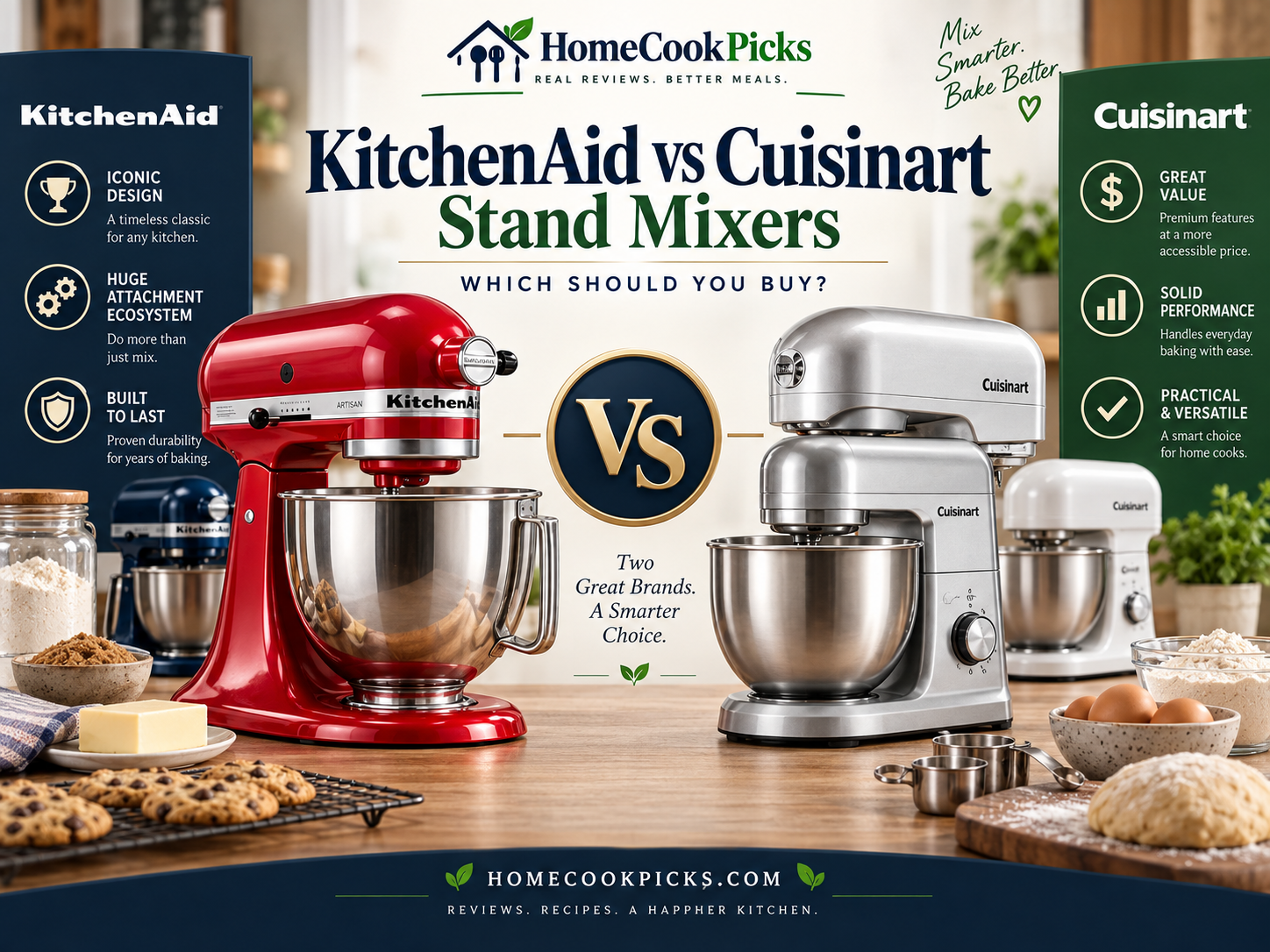
KitchenAid vs. Cuisinart: Start With Your Baking Routine
A stand mixer can make baking more repeatable, but the right choice is not just about brand recognition. Bowl size, head or bowl-lift movement, counter space, included tools, and the kinds of recipes you make all determine whether a mixer becomes a weekly helper or a heavy appliance that rarely leaves the cabinet.
This guide compares five useful routes: three KitchenAid formats and two Cuisinart alternatives. Use the quick table to narrow the field, then consider the batch size, storage plan, and workflow that fit your real kitchen. The strongest choice is the model you can set up easily, use confidently, and maintain for the recipes you make most often.
Four Questions That Clarify Your Best Mixer
How much do you mix at once?
A medium-capacity tilt-head mixer is often enough for cookies and regular cakes. Choose a larger bowl-lift format when you consistently double recipes, make dough, or bake for a crowd.
Will it live on the counter?
A stand mixer is easier to use when it has a stable, accessible home. Measure the counter, account for height under cabinets, and consider whether lifting a heavier model from storage is realistic.
Do you prefer tilt-head or bowl-lift?
Tilt-head models can make bowl access and attachment changes feel straightforward. Bowl-lift models may suit a larger, more dedicated machine. The right answer is the one that feels comfortable in your hands.
Which accessories will you actually use?
Start with the basic beater, whisk, and dough hook. Check current compatibility and included tools before paying for a package that includes accessories you do not expect to use.
Compare the Five Stand Mixer Options
These are editorial matching notes, not firsthand performance measurements. Current pricing, availability, included tools, and accessory bundles can change, so use the product links to check the live listing before buying.
| Best for | Stand mixer | Why consider it | Shop |
|---|---|---|---|
| Best everyday KitchenAid | KitchenAid Artisan Series 5-Quart Tilt-Head Stand Mixer (KSM150) | A traditional tilt-head choice for everyday cakes, cookies, and routine baking. | View on Amazon |
| Best for large batches | KitchenAid Professional 600 Series 6-Quart Bowl-Lift Stand Mixer (KSM600) | A larger bowl-lift format for cooks who regularly make substantial batches. | View on Amazon |
| Best accessible KitchenAid | KitchenAid Classic Series 4.5-Quart Tilt-Head Stand Mixer (K45SS) | A straightforward KitchenAid route for standard home-baking projects. | View on Amazon |
| Best Cuisinart alternative | Cuisinart SM-50 5.5-Quart Stand Mixer | A medium-capacity alternative worth comparing beside KitchenAid tilt-head models. | View on Amazon |
| Best value-focused Cuisinart | Cuisinart Precision Master 5.5-Quart Stand Mixer (SM-55) | A 5.5-quart value route for buyers comparing features against price. | View on Amazon |
Compare the Workflow, Not Just the Label
Capacity and recipe style
Match the bowl to your ordinary recipes. A larger capacity is useful when it solves a regular problem; it can be unnecessary bulk when you mostly make small batches.
Countertop footprint
Stand mixers occupy meaningful space and are most useful when setup is painless. A compact tilt-head machine can be an easier everyday partner, while a larger bowl-lift model rewards a dedicated baking station.
Attachment ecosystem and included tools
Optional tools can expand a mixer, but only when they match the way you cook. Check compatibility for the exact model and confirm what is included before treating accessory potential as a deciding factor.
Maintenance and long-term use
Keep the mixer clean, use it within the manufacturer’s guidelines, and store attachments where they will not be misplaced. A well-cared-for basic model is often a better purchase than a feature-heavy machine that does not suit your routine.
Pair Your Mixer With the Tools That Support Better Baking
A stand mixer is most useful when the rest of the baking setup supports it. Explore our cake pans guide for reliable baking forms and our baking sheets guide for everyday oven work. A simple digital scale and a dependable set of measuring cups can also make favorite recipes easier to repeat.
Add pieces gradually based on recipes you already make rather than buying a crowded collection before you understand your needs.
Choose the Mixer That Fits Your Batches and Your Space
Choose the KitchenAid Artisan when you want a familiar, versatile tilt-head mixer for regular baking. Consider the Professional 600 for larger, more demanding batches, and the Classic Series when you want a more accessible KitchenAid starting point. On the Cuisinart side, the SM-50 and Precision Master offer medium-capacity alternatives worth comparing carefully on price, included tools, and day-to-day feel.
The best stand mixer is the one that matches your countertop, your most common recipes, and the amount of baking you genuinely do. Start with that reality, then let the specific model earn its place in your kitchen.


