
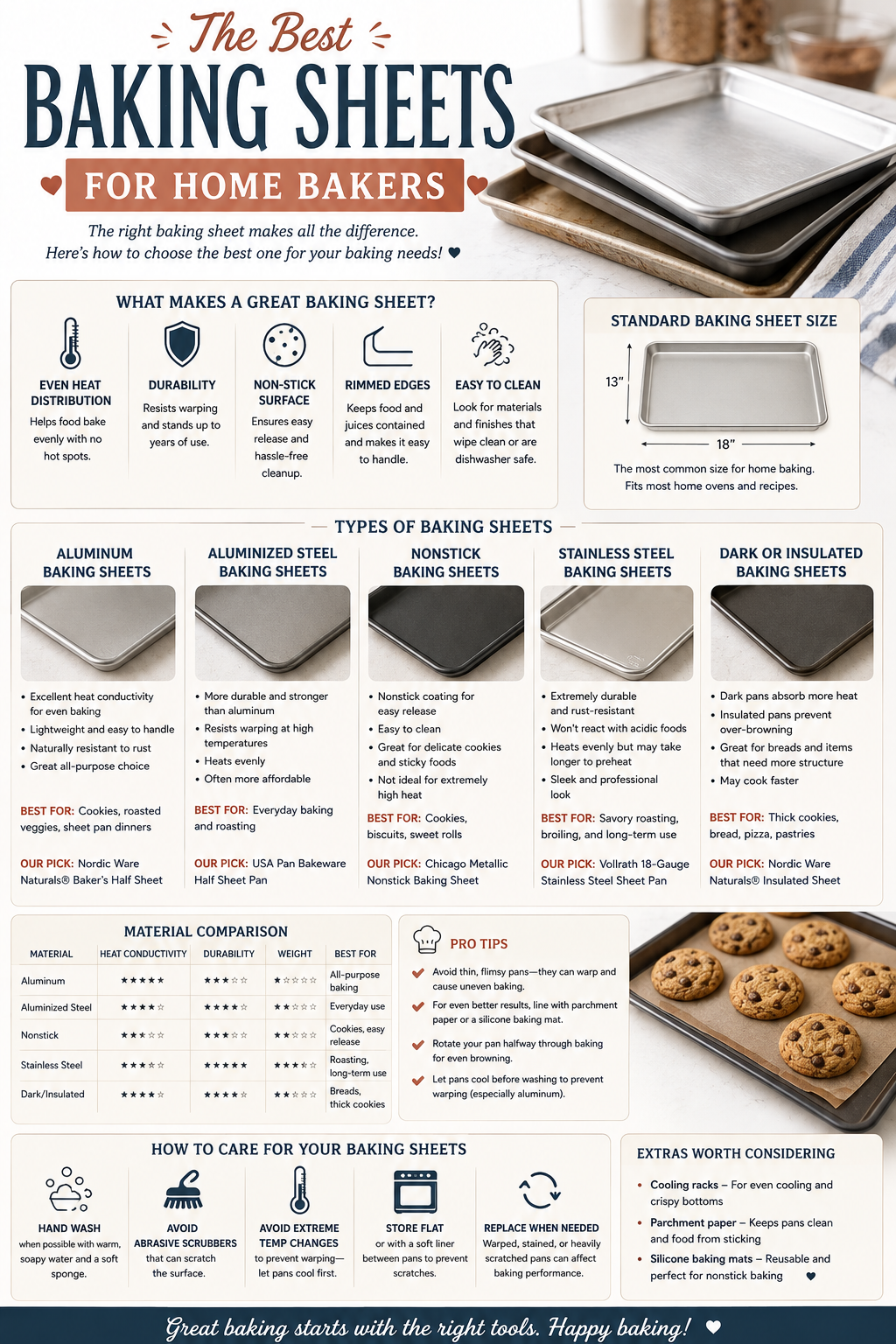
A reliable baking sheet should heat evenly, feel secure in oven-mitted hands, resist permanent warping and survive years of cookies, pastries and weeknight sheet-pan meals. For most home bakers, the Nordic Ware Naturals Baker’s Half Sheet is the best place to start. Its uncoated aluminum surface, reinforced rim, practical half-sheet dimensions and 500°F manufacturer rating make it more versatile than most coated pans.
Not every baker needs the same surface, though. The USA Pan Nonstick Half Sheet is easier to clean after sticky bakes, the Great Jones Holy Sheet is made for cooks who want attractive serve-from-the-pan bakeware, and a quarter-sheet pan is often more convenient for small batches. The six recommendations below cover those different priorities without pretending one design is perfect for everyone.
Editorial note: These selections are based on current manufacturer specifications, product construction, intended use and a review of independent comparative testing. HomeCookPicks did not conduct a new standardized hands-on test for this edition. Specifications and availability were checked during the September 2026 editorial review and should be rechecked before publication.
Affiliate disclosure: HomeCookPicks may earn a commission when you purchase through links on this page. This does not affect which products we recommend or the price you pay.
The best baking sheets at a glance
| Recommendation | Construction | Approximate size | Best for | Main limitation |
|---|---|---|---|---|
| Nordic Ware Naturals Baker’s Half Sheet | Uncoated aluminum with reinforced steel rim | 17.9 × 12.9 × 1 in. | Best overall; cookies, pastries and general baking | Hand washing is recommended |
| USA Pan Nonstick Half Sheet Pan | Aluminized steel with silicone nonstick coating | 17.75 × 12.75 × 1 in. outer dimensions | Sticky doughs and easy release | 450°F limit; coating requires gentler care |
| USA Pan Bare Half Sheet Pan | Uncoated aluminized steel | 17.75 × 12.75 × 1 in. outer dimensions | Bakers who want a heavier uncoated pan | Food may need parchment, grease or flour |
| Great Jones Holy Sheet | Aluminized steel with ceramic nonstick coating | 18.5 × 13.5 × 1 in. | Color, presentation and easy cleanup | Larger and heavier than basic aluminum pans |
| Nordic Ware Naturals Baker’s Quarter Sheet | Uncoated aluminum with reinforced rim | About 13 × 9 × 1 in. | Small batches and compact ovens | Roughly half the capacity of a half sheet |
| Nordic Ware Naturals Half Sheet with Lid | Uncoated aluminum pan with plastic storage lid | 17.9 × 12.9 × 1 in. pan | Transporting and storing baked goods | Lid is not oven-safe |
Our top pick: Nordic Ware Naturals Baker’s Half Sheet
Best for: Most home bakers who want one dependable, multipurpose pan
Construction: Uncoated aluminum with an encapsulated galvanized-steel rim
Exterior dimensions: 17.9 × 12.9 × 1 inch
Interior cooking surface: 17.1 × 12.1 × 1 inch
Manufacturer oven rating: Up to 500°F; broiler-safe
Care: Hand wash recommended
The Nordic Ware Naturals Baker’s Half Sheet earns our best-overall position because it gets the fundamentals right without adding an expensive or eventually disposable coating. Aluminum responds quickly to temperature changes and distributes heat efficiently, while the light-colored surface is well suited to cookies, biscuits and pastries that can overbrown on darker pans.
Nordic Ware reinforces the perimeter with an encapsulated galvanized-steel rim. That reinforcement matters because every metal sheet pan expands as it heats. Thin pans may twist or make a startling popping sound in the oven, while a properly reinforced rim helps the pan return to and retain its intended shape. No manufacturer can realistically promise that a sheet pan will never flex under every temperature change, but this design is more substantial than a flimsy supermarket tray.
The rimmed half-sheet format is also the most versatile size for a typical full-size home oven. The one-inch edge keeps cookie dough, granola, roasting juices and shallow sheet cakes contained. It provides enough usable area for a standard batch of cookies without becoming as awkward as a commercial full-sheet pan, which generally will not fit in a residential oven.
There is no applied nonstick coating to scratch or wear away. Parchment paper or a reusable silicone baking mat can provide easy release when a recipe needs it. That makes this pan a practical choice for bakers who want to use the same sheet for cookies today, high-temperature roasting tomorrow and cooling or prep work later in the week.
What we like
- Light, responsive aluminum construction
- Reinforced rim for additional rigidity
- Uncoated surface that cannot lose a nonstick finish
- Useful one-inch rim
- Rated by Nordic Ware to 500°F and for broiler use
- Widely available in single-pan and multipan packages
- Made in the United States from domestic and imported materials
- Lifetime warranty according to the current manufacturer listing
What could be better
- Automatic dishwashing can discolor aluminum, so hand washing is recommended
- Bare aluminum develops scratches and a darker patina over time
- Acidic foods can discolor or react with an unlined aluminum surface
- Sticky foods may require parchment, a silicone mat, grease or flour
Who should buy it
Choose the Nordic Ware Naturals half sheet if you want a durable everyday baking surface and do not mind washing it by hand. It is especially sensible for cookies, scones, biscuits, croissants, slab pies, granola and bread rolls. It also works for roasting vegetables and preparing sheet-pan dinners, provided acidic marinades and tomato-heavy foods are separated from the aluminum with parchment or another appropriate liner.
Who should skip it
Skip it if dishwasher cleaning is non-negotiable or you specifically want a coated surface. A baker with a very small oven should measure the rack first and may be happier with the quarter-sheet version below.
Buying button: Check the latest price for the Nordic Ware Naturals Baker’s Half Sheet
Best nonstick baking sheet: USA Pan Nonstick Half Sheet Pan
Best for: Sticky bakes, quick release and easier cleanup
Construction: Aluminized steel with USA Pan’s Americoat silicone coating
Baking surface: 17.25 × 12.25 × 1 inch
Outer dimensions: 17.75 × 12.75 × 1 inch
Manufacturer oven rating: Up to 450°F
Care: Follow the manufacturer’s nonstick-care instructions; avoid sharp metal tools
The USA Pan Nonstick Half Sheet is a strong alternative for a baker who values release and cleanup more than maximum-temperature versatility. Its aluminized-steel body feels more substantial than a thin aluminum sheet, while the corrugated baking surface reduces the amount of food that sits directly against the pan.
USA Pan coats the surface with Americoat, its proprietary silicone-based nonstick finish. That is useful for soft cookies, sticky buns, bars and pastries that can cling to an uncoated surface. It may also reduce the amount of grease needed, although you should continue following the recipe rather than assuming every bake can go directly onto the pan.
The tradeoff is longevity and heat tolerance. Any coated sheet requires more careful treatment than an uncoated pan. Metal utensils, knives, abrasive scrubbers and harsh cleaning can damage the finish. USA Pan lists a 450°F maximum, so this is not the pan we would choose for broiling or recipes that demand very high heat.
Aluminized steel also behaves differently from bright aluminum. It can retain heat longer and encourage stronger browning, particularly when combined with a darker or well-used finish. Home bakers should begin checking delicate cookies a minute or two earlier when switching from a light aluminum sheet to a heavier coated pan.
What we like
- Easy-release silicone nonstick surface
- Rigid aluminized-steel body
- Corrugated surface designed to reduce direct contact
- Comfortable half-sheet capacity
- Made in the United States from globally sourced materials according to USA Pan
What could be better
- 450°F ceiling is lower than the Nordic Ware top pick
- Coating will not be as abuse-tolerant as bare metal
- Corrugations take more attention to clean when residue settles into the channels
- Darker surfaces can brown cookie bottoms faster
Who should buy it
Choose the USA Pan if you frequently bake sticky doughs and want dependable release with less scrubbing. It is also a good fit for a baker who prefers the weight and rigidity of aluminized steel.
Who should skip it
Skip it if you regularly bake above 450°F, use a broiler or want a surface that can be scraped and scrubbed without worrying about a coating.
Buying button: Check the latest price for the USA Pan Nonstick Half Sheet
Best uncoated aluminized-steel pan: USA Pan Bare Half Sheet Pan
Best for: Bakers who want a heavier, coating-free alternative to aluminum
Construction: Bare, uncoated aluminized steel
Baking surface: 17.25 × 12.25 × 1 inch
Outer dimensions: 17.75 × 12.75 × 1 inch
Manufacturer oven rating: Up to 450°F
The bare USA Pan combines a steel core with an aluminum-alloy surface and leaves off the nonstick coating. It occupies a useful middle ground: more substantial than many basic aluminum sheets, but without a finish that can be scratched through or worn away.
This is the better USA Pan choice for people who prefer parchment and want their bakeware to age naturally. The manufacturer recommends flouring, greasing or using parchment as appropriate. That is not a serious disadvantage for many home bakers, since parchment also simplifies cleanup and makes transferring batches between the pan and a cooling rack easier.
Because this pan is uncoated, buyers sometimes assume it can be used at any temperature. That is not the case. USA Pan lists a maximum of 450°F for this model. The limit makes it appropriate for nearly all cookies, pastries and breads but less flexible than the 500°F Nordic Ware pan for high-heat cooking.
What we like
- No applied nonstick coating
- Heavier aluminized-steel construction
- Familiar half-sheet proportions
- Suitable for bakers who already use parchment or silicone mats
- Less concern about cosmetically scratching a coating
What could be better
- Food release requires appropriate preparation
- Heavier than a basic aluminum pan
- Maximum temperature is 450°F
- Steel-based bakeware may hold heat longer, so baked goods should be moved to a cooling rack when the recipe calls for it
Who should buy it
Choose this version if you want uncoated bakeware but prefer the feel of aluminized steel. It is particularly appealing for bread rolls, biscuits, bar cookies and bakers who line every pan anyway.
Who should skip it
Skip it if you want the lightest possible sheet pan, effortless release directly from the metal or broiler compatibility.
Buying button: Check the latest price for the USA Pan Bare Half Sheet
Best-looking baking sheet: Great Jones Holy Sheet
Best for: Bakers who want colorful bakeware that can go from oven to table
Construction: Aluminized steel with a ceramic nonstick coating
Dimensions: 18.5 × 13.5 × 1 inch
Manufacturer oven rating: Up to 450°F
Care: Dishwasher-friendly according to the brand, although hand washing is gentler on a coated surface
Most sheet pans are utilitarian silver rectangles. The Great Jones Holy Sheet takes a different approach with saturated colors and a ceramic nonstick cooking surface. It is the pick for a home baker who serves cookies, focaccia or a sheet-pan supper directly from the bakeware and wants the pan to feel intentional on the table.
The aluminized-steel construction is substantial, and the one-inch rim is useful for both sweet and savory recipes. Great Jones lists the pan as oven-safe to 450°F. Its ceramic coating offers easier release and cleanup than bare metal, although it demands the same sensible precautions as other nonstick finishes: avoid cutting on the pan, metal utensils and abrasive cleaning.
The larger 18.5-by-13.5-inch footprint deserves attention. That extra half inch can be the difference between fitting and catching on the sides of a compact oven. Measure the narrowest usable portion of your oven rack—and account for protruding handles or rails—before ordering.
What we like
- Distinctive color choices
- Ceramic nonstick cooking surface
- Rigid aluminized-steel construction
- Attractive enough for casual serving
- Dishwasher-friendly according to the manufacturer
What could be better
- Costs more than basic uncoated aluminum
- Larger and heavier than our top pick
- 450°F temperature limit
- A colored coating can show chips, scratches and baked-on marks over time
- May be too wide for some compact ovens
Who should buy it
Choose the Holy Sheet if appearance matters, you like an easy-release surface and you have confirmed that its exterior dimensions fit your oven.
Who should skip it
Skip it if you want the least expensive workhorse, regularly use temperatures above 450°F or prefer bakeware that can be scrubbed aggressively.
Buying button: Check the latest price for the Great Jones Holy Sheet
Best for small batches: Nordic Ware Naturals Baker’s Quarter Sheet
Best for: Small households, toaster ovens and half batches
Construction: Uncoated aluminum with a reinforced rim
Approximate exterior size: About 13 × 9 × 1 inch; verify the exact selected model before linking
Care: Hand wash recommended
A quarter-sheet pan is not merely a miniature novelty. It is often the pan that gets used most because it is easy to carry, clean and fit into a crowded kitchen. It handles a half batch of cookies, a small group of biscuits, toasted nuts, a few pastries or reheating tasks without requiring the space and water needed to clean a half sheet.
Nordic Ware’s quarter-sheet design uses the same general formula that makes the half sheet useful: natural aluminum, a rimmed edge and reinforcement around the perimeter. The smaller surface is naturally more rigid, and two quarter sheets can sometimes fit side by side on a large oven rack. Do not assume that arrangement will work in every oven; measure the rack and leave room for air circulation.
Quarter sheets are also helpful for keeping components separate. A baker can toast nuts on one pan while another component bakes on a half sheet, or use two smaller pans for doughs with different toppings.
What we like
- Convenient for small batches
- Easier to wash and store than a half sheet
- Uncoated aluminum surface
- Useful for ingredient prep, freezing and reheating
- Better fit for some countertop ovens
What could be better
- Roughly half the usable area of a half sheet
- Too small for a full standard batch of many cookie recipes
- Not every quarter sheet fits every toaster oven
- Hand washing is recommended
Who should buy it
Choose a quarter sheet if you bake for one or two people, regularly make half batches or own a countertop oven that cannot accept a half sheet. Many active bakers will benefit from owning quarter sheets in addition to—not instead of—two half sheets.
Who should skip it
Skip it as your only pan if you routinely bake full batches, prepare sheet cakes or need room to space cookies properly.
Buying button: Check the latest price for the Nordic Ware Naturals Quarter Sheet
Best for storage and transport: Nordic Ware Naturals Half Sheet with Lid
Best for: Cookie decorators, bake sales, potlucks and advance preparation
Construction: Uncoated aluminum half sheet with a polypropylene storage lid
Pan interior: 17.1 × 12.1 × 1 inch
Manufacturer oven rating: Pan up to 500°F and broiler-safe; lid is never oven-safe
Care: Hand wash the pan and lid
The lidded version pairs Nordic Ware’s aluminum half sheet with a fitted plastic cover. The pan performs the same basic jobs as the standard Naturals model, while the lid protects cookies, bars and prepared ingredients during storage or transport.
That combination is particularly useful for decorated cookies, which can be damaged by plastic wrap, and for bar cookies that need to travel to a gathering. The lid also allows covered pans to stack more neatly in a refrigerator. It is a storage cover, not a baking accessory: Nordic Ware explicitly says the lid must not enter the oven.
The lidded model costs more and adds another item to store, so it is unnecessary for a baker who cools everything on racks and transfers finished goods to separate containers. But for anyone who regularly carries a full pan of baked goods, the fitted cover is more secure and reusable than improvised foil or plastic wrap.
What we like
- Proven uncoated aluminum half-sheet format
- Reusable fitted cover
- Helpful for delicate decorated cookies and bar desserts
- Easier stacking during storage and transport
- Pan is rated to 500°F and for broiling
What could be better
- Lid cannot go in the oven
- Costs more than the pan alone
- Bulky to store when the cover is not needed
- The cover does not turn the pan into a leakproof transport container
Who should buy it
Choose the lidded pan if you take cookies to parties, run bake sales, decorate cookies in advance or frequently store prepared food directly on a sheet pan.
Who should skip it
Skip it if you already own a suitable half sheet and airtight storage containers, or if cabinet space is tight.
Buying button: Check the latest price for the Nordic Ware Half Sheet with Lid
How we selected these baking sheets
For this edition, HomeCookPicks compared current manufacturer information for material, dimensions, rim construction, coatings, care and maximum oven temperature. We also reviewed independent comparative coverage to identify recurring performance considerations, including browning, handling, warping, food release and cleanup.
The recommendations were evaluated against six questions:
- Does the material make sense for baking? Aluminum and aluminized steel dominate this list because both conduct heat effectively and are widely used in home and professional bakeware.
- Is the pan substantial enough for repeated use? Reinforced rims and heavier construction reduce permanent deformation, although temporary movement can still occur as metal expands.
- Is the surface appropriate for the intended baker? Uncoated pans emphasize longevity and temperature flexibility; coatings emphasize release and cleanup.
- Will it fit a typical home oven? Half sheets are generally residential-oven friendly, but exterior measurements still vary.
- Can a baker handle it safely? A usable rim and manageable weight matter when the pan is hot and loaded.
- Does the product offer a reason to choose it? Every pick serves a distinct need rather than repeating the same recommendation at different prices.
We did not assign numerical performance scores or claim original test results. A future HomeCookPicks hands-on update should bake the same cookie dough on every pan, rotate pans consistently, record browning across zones, measure flatness before and after thermal cycling, and evaluate release and cleaning with the same recipes.
How to choose the right baking sheet
Start with a rimmed half sheet
For most homes, a rimmed half sheet is the most useful first purchase. Its exterior dimensions are usually close to 18 by 13 inches, although brands vary. The rim contains liquid, keeps food from sliding off and gives gloved hands something secure to hold.
A rimless cookie sheet can make sliding parchment and cookies onto a cooling surface easier, but it is less useful for granola, sheet cakes, roasting or anything that releases fat or juice. Unless you bake cookies almost exclusively, begin with a rimmed pan.
Aluminum versus aluminized steel
Uncoated aluminum heats and cools quickly. Its light color helps moderate bottom browning, making it an excellent general-purpose material for cookies and pastries. It will scratch and develop a patina, and dishwasher detergent can create cosmetic discoloration.
Aluminized steel uses a steel core with an aluminum-alloy coating. It is typically heavier and more rigid. It can retain heat longer than thin aluminum, which may deepen browning but can also continue cooking a cookie after the pan leaves the oven.
Neither material is universally better. Bakers who want a light, responsive workhorse should begin with aluminum. Those who prefer a heavier feel or a specific coated surface may prefer aluminized steel.
Uncoated versus nonstick
Uncoated pans are the longevity choice. Scratches may affect appearance, but there is no applied release layer to wear away. Parchment or silicone mats can be added only when needed.
Nonstick pans simplify release and cleanup, especially with sticky doughs. Their disadvantages are lower maximum temperatures and more restrictive care. A scratched or deteriorating coated sheet should be replaced according to the manufacturer’s guidance.
Dark surfaces also absorb heat differently from bright aluminum. When moving a familiar cookie recipe to a darker nonstick pan, watch the first batch closely and begin checking early.
Measure your oven, not just the rack
Measure the narrowest usable width and depth with the oven cool. Account for side rails, rack lips, handles and the clearance needed for airflow. A product described as a “half sheet” can still differ by more than half an inch from another brand.
Countertop and toaster ovens vary even more. Use the manufacturer’s maximum bakeware dimensions rather than assuming that any quarter sheet will fit.
Buy two matching half sheets when possible
Two matching pans make batch baking more predictable. They heat at the same rate, stack neatly and let one batch cool while another bakes. Matching pans also make side-by-side comparisons less confusing than switching between a bright aluminum pan and a dark coated sheet.
How to prevent baking sheets from warping
Metal expands when heated, so an occasional pop or temporary twist does not automatically mean a pan is ruined. Permanent distortion is the real problem. You can reduce stress on a pan by avoiding sudden temperature shocks, such as rinsing a hot sheet under cold water.
Use pans within their manufacturer-rated temperature. Avoid placing a large frozen item on one part of a hot pan, and distribute food reasonably evenly. Reinforced rims and thicker metal improve rigidity, but no ordinary sheet pan is immune to physics.
If a pan rocks noticeably on a flat counter after it has completely cooled, replacement may be appropriate—especially when pooled butter or batter would affect baking results.
How to clean and maintain a baking sheet
Let the pan cool before washing. Use warm water, dish soap and a nonabrasive sponge unless the manufacturer allows something stronger. For uncoated aluminum, accept that scratches and patina are normal signs of use rather than performance failures.
Avoid automatic dishwashers for bare aluminum when the manufacturer recommends hand washing. The detergent can darken or discolor the metal. This is generally cosmetic, but it is preventable.
Treat every coated pan more gently. Do not cut baked goods directly on the surface, stack sharp metal items inside it without protection or use abrasive pads. A sheet of paper towel or a thin pan protector between stacked coated sheets can prevent scratches.
Final verdict
The Nordic Ware Naturals Baker’s Half Sheet is the best baking sheet for most home bakers. It offers the useful capacity of a rimmed half sheet, responsive uncoated aluminum, a reinforced perimeter and greater high-temperature flexibility than the coated alternatives in this guide. Buying two matching pans gives most households a dependable foundation for cookies, pastries, bread and everyday oven cooking.
Choose the USA Pan Nonstick Half Sheet if easy release is your highest priority, the USA Pan Bare Half Sheet if you prefer heavier uncoated aluminized steel, or the Great Jones Holy Sheet if presentation and color matter. Add a Nordic Ware quarter sheet for small jobs, and consider the lidded Nordic Ware half sheet if you frequently store or transport baked goods.
The best pan is ultimately the one that fits your oven, suits your recipes and receives the care its material requires. Measure first, respect the temperature rating and choose the surface based on how you actually bake—not on a feature list you will never use.
Sources and specification references
- Nordic Ware Naturals Baker’s Half Sheet manufacturer page
- Nordic Ware Naturals Baker’s Half Sheet with Lid manufacturer page
- USA Pan Nonstick Half Sheet manufacturer page
- USA Pan bakeware manufacturer site
- Great Jones Holy Sheet manufacturer page
- Google Search Central guidance for high-quality product reviews
Build a Better Home-Baking Setup
These HomeCookPicks guides cover related bakeware and preparation tools.


